Table of Contents
ToggleKey Takeaways
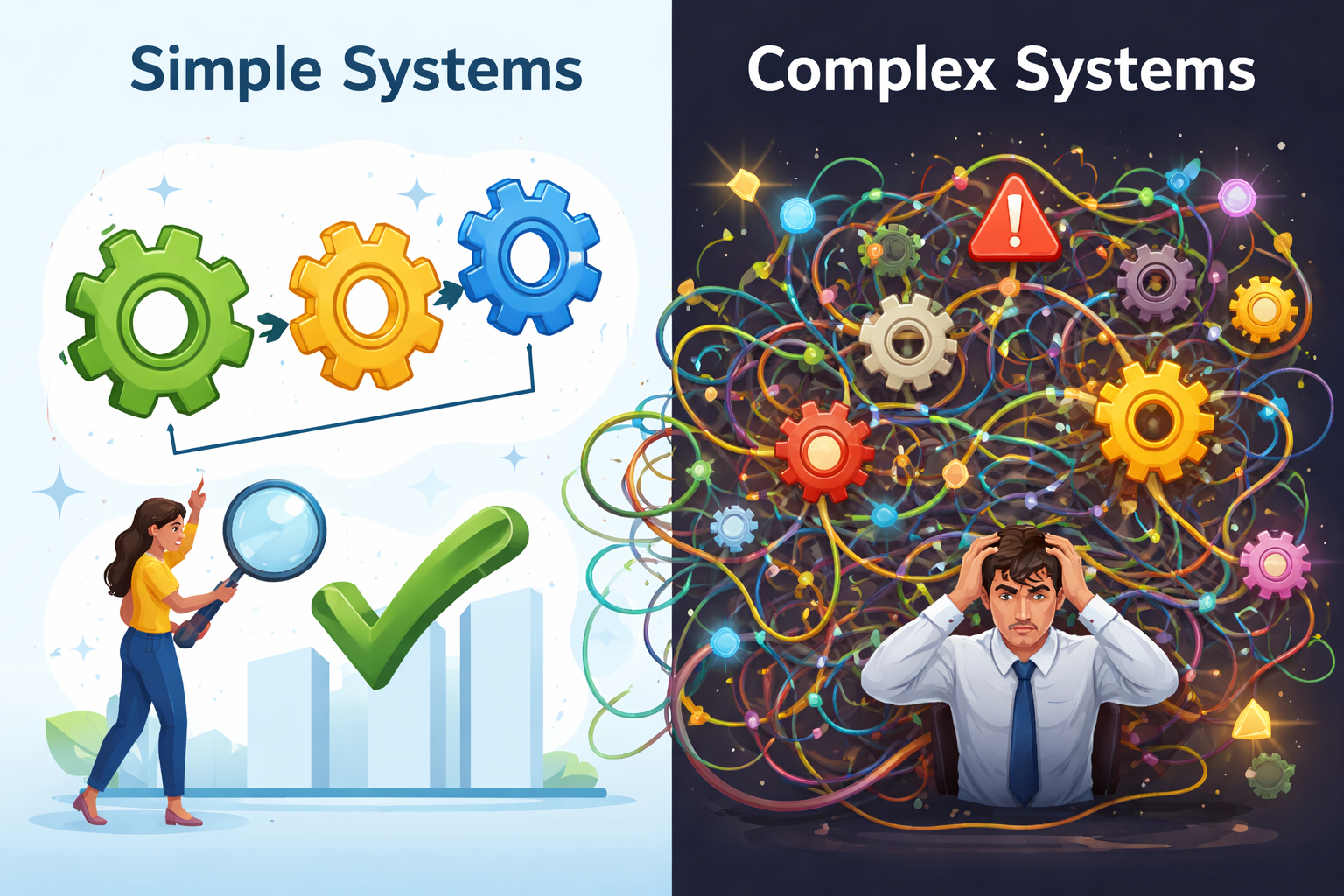
Simple systems feature direct cause-and-effect relationships with few components, while complex systems exhibit emergent behavior, feedback loops, and unpredictable interactions that no single person can fully understand.
Complexity becomes a liability when it stops increasing outcomes like safety, performance, or profit, but continues to increase cost, failure risk, and cognitive load on your teams.
Many high-profile failures from 2020 to 2025—including software outages, infrastructure meltdowns, and financial crises—weren’t caused by insufficient technology but by poorly managed complexity that spiraled beyond human control.
You can apply concrete criteria and checklists to determine whether your system’s complexity is still serving you or actively working against you.
The goal isn’t eliminating complexity but containing it: pushing necessary complexity down into specialized components while keeping day-to-day operations as simple as possible for human beings to manage.
Introduction: Why Our World Keeps Choosing Complex Over Simple
Picture a 1950s mechanical light switch. You flip it up, the light turns on. Flip it down, the light turns off. One moving part, one function, zero failure modes beyond physical breakage.
Now consider a modern smart lighting system. It connects to WiFi, syncs with your phone app, integrates with voice assistants, runs firmware updates, and coordinates with your home automation hub. It can fail because the cloud server is down, your router rebooted, the app needs updating, or a firmware patch introduced a bug. The light still does the same thing—turn on and off—but the path to that outcome has multiplied into dozens of potential failure points.
From 2000 to 2025, digitalization, globalization, and AI integration have pushed many domains from simple or merely complicated into truly complex territory. Finance evolved from ledger books to algorithmic high-frequency trading meshes. Healthcare IT transformed paper charts into interconnected EHR systems spanning multiple hospitals. Supply chains optimized for just-in-time efficiency became fragile networks that collapsed under COVID-19 pressure. All this illustrates the multitude of factors and interconnectedness that define modern systems, making the landscape far more nuanced than it first appears.
This article addresses a fundamental requirement for anyone building or managing systems today: understanding where complexity helps and where it starts to hurt. We’ll cover concrete definitions, the surprising power of simplicity, real-world failures driven by runaway complexity, and practical methods to decide how much complexity to allow in your world. Since the future is inherently unpredictable, understanding current complexity is essential for organizations to prepare for upcoming challenges and adapt to changing conditions.
Simple, Complicated, and Complex Systems: Clear Definitions With Concrete Examples
Understanding the distinction between simple and complicated systems—and how both differ from complex ones—forms the foundation for every decision that follows. These categories exist on a spectrum used across systems theory, engineering, management, and software development.
Think of it this way: the nature of a system determines how you can predict, control, and fix it. For example, complex systems include things like ecosystems, economies, the internet, and the human body, all of which are composed of many interacting components. In such systems, simple approaches often fail because their interconnected and unpredictable nature requires more nuanced solutions.
Simple Systems
A simple system has direct cause-and-effect relationships, few components, and low ambiguity. You can fully understand how it works by looking at its constituent parts.
Examples include:
A mechanical pencil: press the top, lead advances
A three-ingredient recipe like shortbread: butter, sugar, flour
A basic thermostat: temperature drops below threshold, heater turns on
Simple systems are entirely knowable. Anyone can grasp the function quickly, and failure risk stays low because there are few interaction points between components.
Complicated Systems
Complicated systems involve many components with mostly predictable interactions. They require expertise to understand, but once you map the links, behavior follows definite patterns.
Examples include:
A modern car engine with hundreds of parts (pistons, valves, fuel injectors)
A commercial airliner with thousands of engineering specifications
Landing SpaceX Falcon 9 boosters on drone ships—repeatable tasks with known physics
Complicated problems can be solved through analysis. Given enough expertise and time, you can create blueprints, simulations, and procedures that predict outcomes reliably.
Complex Systems
Complex systems feature feedback loops, adaptation, emergent behavior, and strong dependence on context. The total system behaves in ways that cannot be predicted by examining individual components alone.
Examples include:
The 2008 global financial system with self-reinforcing derivative trading loops
City-scale traffic patterns where local driver decisions aggregate into unpredictable gridlock
Social media influence networks circa 2015-2025 where content spread defied all moderation models
In complex systems, small changes can produce outsized effects. Local optimizations create global instability. The same piece of software can be simple, complicated, or complex depending on scale and human interactions—a single microservice behaves predictably, but a global microservices mesh involving dozens of teams becomes a complex adaptive system where human behavior matters as much as code.

How Simple Systems Behave (And Why They’re So Powerful)
Simple systems are not naive or primitive. They are often remarkably robust and effective, especially those operating under stress conditions where humans need to make rapid decisions.
Key Properties of Simple Systems
Few moving parts: Less that can break, fewer combinations of possible states
Transparent cause-and-effect: Anyone can trace what happened and why
Low coordination overhead: No need for complex communication between components
Fast learning curves: New users become competent quickly
Where Simple Systems Excel
Consider the WHO Surgical Safety Checklist, introduced around 2008. This simple tool—19 binary checks on paper—reduced surgical mortality by 47% and complications by 36% across eight hospitals globally, according to research published in the New England Journal of Medicine. It succeeded precisely because it bypassed complex digital operating room systems prone to glitches.
Paper checklists, manual kill-switches, and simple rules like “save 20% of income” outperform sophisticated alternatives in high-stress environments. Vanguard studies found that simple personal finance guidelines correlate with higher net worth accumulation than bespoke algorithmic advisors during volatile markets.
Simple systems shine when resources are limited, staff turnover is high, or people operate under crisis conditions. During Hurricane Katrina in 2005, ad-hoc paper logistics outperformed tangled federal IT systems. In wartime, simple “pay as you go” ration systems avoided supply chain complexity that would have collapsed under pressure.
A Mini-Case: When Simple Backups Save Lives
In 1989, United Airlines Flight 232 lost all hydraulic systems—a catastrophic failure that crippled the plane’s complex fly-by-wire controls. The pilots reverted to a simple manual method: controlling the aircraft using only engine thrust on left and right sides. This crude but understandable approach enabled a belly landing that saved 185 of 296 people aboard.
The lesson: when layered complexities fail, simple backups that humans can reason about in real-time become the difference between survival and disaster.
How Complex Systems Behave (And Why They Fail in Surprising Ways)
Complex systems aren’t inherently wrong. Modern society depends on them—global finance, healthcare networks, power grids. But their behavior is counterintuitive, and their failures often surprise even experts who designed them. A car crash is a classic example of how complex systems, such as transportation networks, can fail in unpredictable ways.
Complex systems often demonstrate reduced reliability, inefficiency, and increased error rates.
Trademark Characteristics of Complex Things
Characteristic | What It Means | Example |
|---|---|---|
Nonlinearity | Small inputs cause outsized effects | Knight Capital lost $440M in 45 minutes from reactivated obsolete code |
Feedback loops | Effects become causes, amplifying or dampening | 2010 Flash Crash: one sell order triggered $1 trillion market drop |
Delayed consequences | Actions today create problems tomorrow | Just-in-time inventory seemed efficient until COVID exposed fragility |
Emergent behavior | Whole system does things no part was designed to do | Social media algorithms amplified misinformation nobody planned |
Unknown unknowns | Failure modes nobody anticipated | 2021 Texas blackout from frozen sensors interacting with market rules |
Historical Examples: 2000-2025
The 2008 financial crisis exemplifies complexity liability at global scale. Collateralized debt obligations (CDOs) sliced mortgage risks into tranches that appeared to diversify risk. But emergent correlations during the housing downturn created self-reinforcing feedback loops. The end result: $10 trillion in global losses from a complex system designed to reduce risk.
COVID-19 exposed supply chain complexity in 2020-2021. Just-in-time inventory models, optimized locally, caused global shortages. The semiconductor crisis delayed automotive production by months and cost billions—not because factories couldn’t produce chips, but because the entire system had no buffer against disruption.
Major cloud outages illustrate the same pattern. The 2021 AWS US-East-1 incident started from a configuration error and rippled to Netflix, Slack, and countless other services. Each microservice worked correctly in isolation. But subtle interdependencies created cascading failures that affected millions.
The Cognitive Distance Problem
In complex systems, no single person can fully understand the whole. This matters because coordination becomes harder, accountability diffuses, and root-cause analysis often reveals that many factors contributed to failure in ways nobody anticipated. In such situations, people have a natural need to make sense of complex failures, which can lead to elaborate explanations. Conspiracy theories are a symptom of our desire to find complexity in the world, as they provide elaborate explanations for chaotic events.
As systems theorist John Gall observed, complex systems that actually work in practice typically do so because of heroic interventions from people improvising solutions nobody planned.

When Complexity Becomes a Liability: Clear Warning Signs
Complexity crosses from asset to liability once it adds more risk and cost than value. This isn’t a matter of opinion—you can recognize it through observable warning signs that appear consistently across industries.
High-Level Criteria
Your complexity has likely become a liability when you observe:
Rising failure rates despite more controls: Adding safety layers increases rather than decreases incidents
Growing diagnosis time: Finding root causes takes days instead of hours
User confusion: End users and operators frequently misuse or misunderstand the system
Extended onboarding: New staff require months to become effective
Combinatorial explosion of possible states: Too many configurations to test or document
Concrete Examples
In software development, deployment times ballooned from minutes in 2015 to days by 2024 for many organizations. DORA State of DevOps reports found that elite performers ship code 208 times faster than low performers—often by maintaining simpler architectures that allow rapid reasoning about changes.
Corporate compliance frameworks provide another example. Post-Enron Sarbanes-Oxley regulations added compliance layers that ballooned costs 20-30% without proportional risk reduction, according to Deloitte analysis. Employees couldn’t follow procedures without consultants, creating a system where the process of demonstrating control became more complex than the control itself.
Organizational Symptoms
Watch for these patterns in your organization:
Constant “heroic” firefighting by a few key people
Increasing reliance on irreplaceable experts who hold undocumented knowledge
Frequent workarounds because official processes are too slow or rigid
Shadow IT emerging because official systems are too complex to use effectively
Google’s SRE research found 50% of outages came from human error in complex configurations
A Rule of Thumb
If reasoning about a change takes longer than implementing it, complexity is probably a liability. If adding another control, feature, or approval step makes the system harder to understand rather than better to use, you’ve crossed the line.
The December 2022 Southwest Airlines meltdown demonstrates cumulative complexity liability. A legacy crew scheduling system failed under winter storm pressure. Outdated software entangled with modern tools created cascading delays. Over 16,000 flights were canceled. The cost exceeded $800 million—not because technology failed, but because decades of accumulated complexity had made the total system impossible to manage under stress.
Cognitive and Cultural Drivers: Why We Keep Choosing Complex Over Simple
Understanding when complexity becomes a liability requires confronting a human problem: our brains and organizations are biased toward complexity even when simpler options exist and perform better.
A key driver of this tendency is complexity bias—a cognitive shortcut where we instinctively prefer complicated solutions and explanations, even when simpler ones are more effective. Complexity bias is a logical fallacy that leads us to give undue credence to complex concepts. Faced with two competing hypotheses, we are likely to choose the most complex one, and we often view something easy to understand as having many difficult parts. Research has revealed our inherent bias towards complexity, as shown in studies where participants preferred complex rules over simple ones. The majority of cognitive biases occur to save mental energy, and complexity bias is another such shortcut. We often find it easier to face a complex problem than a simple one, and when overwhelmed with information, we tend to perceive a topic as more complex than it is, often ignoring the fundamentals.
Complexity bias leads individuals to focus on complicated solutions while ignoring simple, high-impact habits. It also causes us to see complexity where only chaos exists, manifesting in forms such as conspiracy theories and superstition. For example, studies have shown that even pigeons can develop superstitious behavior, believing their actions influence random outcomes. Education can reduce the chances of believing in conspiracy theories, but many educated individuals still hold such beliefs.
Marketers make frequent use of complexity bias by incorporating confusing language and jargon into product packaging, creating a perception of superiority in products—even when the claims are not fully understood by consumers. The use of jargon in communication can alienate people and reinforce complexity bias, making it harder for them to engage with important topics.
Occam’s razor suggests that the simplest solution is usually the correct one, providing a useful tool to help overcome complexity bias.
Complexity Bias in Practice
Research published in Psychological Science (2019) found that experts routinely favored elaborate models over simpler ones that produced equal predictions. This leads people to distrust simple proposals as “too naive” or insufficiently rigorous.
In business and consulting, complex jargon, multi-layered frameworks, and grand strategies function as status markers. A 100-slide deck feels more professional than a one-page summary, even when the one-page version contains all the insight that matters.
Fear and Risk-Shifting
Adding procedures, tools, and approval steps becomes a way for managers and regulators to demonstrate they “did something” after problems occur. This pattern appears invariably found across industries after major incidents. The process of adding complexity feels like progress, even when it complicates operations and creates new failure modes.
Emotional Attachment to Custom Systems
Teams become attached to intricate systems they’ve built over years. Suggesting simplification or replacement threatens their work, their expertise, and sometimes their jobs. This makes it politically difficult to reduce complexity even when everyone recognizes it’s necessary.
A Concrete Vignette
Consider a software company in the 2010s-2020s that layered five different project management frameworks: Scrum, SAFe, OKRs, internal scorecards, and detailed time tracking. Engineers spent more time updating systems than writing code. Meetings about processes exceeded meetings about products.
Basecamp took the opposite approach in 2021, ditching multi-tool stacks (Asana, Slack, Jira combinations) for simple email and calendar workflows. Engineers reclaimed 2-3 hours weekly. Velocity increased 30%. The tools had promised efficiency but delivered coordination overhead that drained productivity.
Designing for the Right Level of Complexity
The goal isn’t to eliminate complexity from your life and work. Some domains inherently require complex systems—global payments, national power grids, urban transportation networks. The goal is choosing where complexity is necessary and how to contain it so humans can still function effectively.
Adopting the right perspective is essential when analyzing and designing complex systems, as it helps identify which complexities are necessary and how to manage them for better system safety and resilience.
Necessary vs. Incidental Complexity
Software architect Ward Cunningham distinguished between necessary complexity (inherent to the problem) and incidental complexity (added by poor design choices). This idea applies broadly:
Type | Definition | Example |
|---|---|---|
Necessary | Complexity required by the problem itself | Quantum-secure encryption for financial transactions |
Incidental | Complexity added by implementation choices | Seven different CRM systems doing the same thing across departments |
Your design task: minimize incidental complexity ruthlessly while managing necessary complexity through proper containment.
Strategies for Containment
Modularity and boundaries: Design subsystems with clear interfaces so internal complexity doesn’t leak into everyday operations. Each module can be complex inside while presenting a simple interface outside. Software developers often encounter complexity bias, where there is a tendency to overcomplicate solutions instead of focusing on fundamental concepts. Recognizing and addressing this bias is crucial for maintaining manageable systems.
Strong, simple interfaces: ATMs abstract massive banking system complexity into 7-step flows. Users don’t need to understand core banking software to withdraw cash. COVID-19 vaccination portals (the successful ones) presented simple booking steps despite extraordinarily complex logistics underneath.
Push complexity down and inward: Place complexity in specialized components, automation, and expert teams. Keep outward-facing flows and decisions simple enough that stressed, tired, or new humans can still function. The same way commercial aircraft hide immense engineering complexity behind controls that trained pilots can operate under pressure.
This principle applies to organizations as much as technology. The frontline should encounter simple processes; the complexity should live in backend systems, specialized teams, and automated processes that don’t require constant attention.
Practical Checklist: Is Complexity Helping or Hurting?
This checklist provides a pragmatic tool you can apply to projects, processes, or systems starting today. At this point, it is critical to assess whether complexity is truly necessary or if it has become a liability. Rate each question green (under control), yellow (concerning), or red (liability), then assess your overall position.
Onboarding and Understanding
Can a new team member grasp the system’s core logic in under two weeks?
Can you explain how a change propagates through the system in under five minutes?
Do written runbooks actually describe how troubleshooting happens, or does everyone improvise via Slack?
Approval and Change Velocity
How many people must say “yes” before a change goes live?
Do approval gates exceed five steps? (Correlates with 3x slower velocity per Atlassian data)
Is deploying a small change as simple as deploying a large one?
Monitoring and Awareness
Do you have more monitoring panels than people who actually watch them?
Can your on-call staff describe the system’s current state in one sentence?
When something fails, do you find out from users or from your own systems?
Failure Patterns
Do incidents often have multiple interacting causes nobody anticipated?
Do you routinely discover undocumented dependencies during outages?
Are fixes increasingly about patching patches rather than addressing root causes?
Red Zone Assessment
If multiple answers fall into red, prioritize a simplification initiative before adding any further tooling, processes, or features. Adding complexity to an already-overburdened system accelerates decline rather than improving outcomes.

Strategies to Reduce or Contain Harmful Complexity
Complexity reduction should be systematic rather than ad hoc. Simplifying often unlocks speed, safety, and innovation simultaneously—the opposite of the tradeoff many organizations assume exists.
Subtraction First Design
Before adding any requirement, feature, approval, report, or integration, ask: what can be safely removed? This method runs counter to most organizational instincts but consistently produces better outcomes.
GitHub’s 2022 audit retired 40% of legacy dependencies, speeding builds by 25%. They didn’t add faster hardware—they removed unnecessary complexity that had accumulated over years.
Standardization and Constraint
Limiting technology stacks, form templates, or approved workflows reduces the combinatorial explosion of variants that create failure modes and training burdens.
Many enterprises consolidated from seven CRM tools to one between 2015-2023. Each additional tool had seemed to solve a specific problem, but the overhead of integration, training, and data synchronization far exceeded any local benefit.
Automation: A Double-Edged Sword
Used carefully, automation hides necessary complexity from end users. Tesla’s Full Self-Driving neural networks mask immense vision processing complexity behind simple steering and acceleration controls.
Used recklessly, automation multiplies opaque interactions and failure modes. The 2024 CrowdStrike incident affected 8.5 million Windows machines due to a channel file mismatch—automation at scale amplifying what would have been a minor error into a global outage.
Periodic Simplicity Audits
Schedule annual reviews (or post-incident reviews) examining architectures, organizational charts, and procedures with explicit authority to retire obsolete components. Ask: what exists because it’s needed, and what exists because nobody has removed it?
A Success Story
Southwest Airlines, post-2022 meltdown, simplified their scheduling system to a Rails monolith architecture. By 2023, cancellation rates dropped 80%. The solution wasn’t more technology—it was less complex technology that humans could actually manage and adapt when conditions changed.
Hospitals that ditched custom EHR modifications for vendor defaults saw 40% fewer outages per KLAS Research. Customization had seemed valuable; the complexity it created wasn’t.
Conclusion: Building Systems That Stay Understandable as They Grow
Complexity is inevitable in many modern systems. Uncontrolled complexity is optional.
The long-term winners—products, organizations, and infrastructures that survive and adapt—keep their essential operations simple enough for human beings to reason about during both calm and crisis. This isn’t about avoiding sophistication. It’s about ensuring that sophistication serves the mission rather than obscuring it.
Distinguish simple vs complicated vs complex. Watch for the warning signs that indicate complexity has crossed into liability territory. Deliberately design for the minimum viable complexity that still achieves your goals.
Looking toward 2025-2035, AI, automation, and interconnected platforms will make this discipline more critical, not less. Systems will become capable of greater complexity—which means the organizations that manage complexity well will dramatically outperform those that simply accumulate it.
Regularly revisit your systems with this question: could a simpler version accomplish 80-90% of what we need, with half the risk?
The answer is often yes. And that simpler version is usually what you should build.
FAQ
These questions address common follow-up concerns not fully covered in the main sections, focusing on practical decisions you’ll face when applying these principles in real organizations.
How do I justify simplification to stakeholders who equate complexity with professionalism?
Present concrete data first. Compare incident counts, time-to-resolution, onboarding duration, and maintenance costs before and after simplification experiments. Numbers make the abstract tangible.
Use external examples from high-reliability industries. Aviation checklists and nuclear plant procedures demonstrate that serious organizations rely on radical simplicity at the sharp end—where humans interact with systems—despite complex backends. Nobody accuses surgeons of being unprofessional for following the WHO checklist.
Frame simplification as risk-reduction and cost-control rather than “dumbing down.” Connect it to regulatory compliance, safety metrics, or customer experience goals that stakeholders already care about.
If skepticism persists, propose small, low-risk pilots. Simplify one workflow, one subsystem, or one product line. Internal evidence from your own context convinces skeptics better than external examples ever can.
Can a complex problem ever be solved with a simple system or solution?
Complex problems often require iterative, adaptive approaches—but individual interventions can still be remarkably simple.
The UK’s 2008 organ donor opt-out policy increased donation rates 20x through a simple default change, according to BMJ research. The problem (increasing organ availability) was complex, involving human behavior, medical logistics, and ethical considerations. The solution was a checkbox.
The danger isn’t simplicity itself but oversimplification that ignores key feedback loops and stakeholders. One-dimensional metrics in education or healthcare exemplify this failure—simple measures that miss what matters.
Start with the simplest model that acknowledges all major forces in play. Add complexity only when specific failures of that simple model appear in practice. Use simple guardrails (caps, buffers, redundancy) to manage complex dynamics rather than attempting to micromanage every variable.
What role does AI play in increasing or reducing system complexity?
AI functions as an amplifier—it can reduce visible complexity while dramatically increasing hidden complexity.
Modern AI systems (post-2020 large language models and beyond) hide intricate logic in models, data pipelines, and monitoring requirements. A user sees a simple chat interface; behind it runs infrastructure that no single person fully understands. This transforms complicated systems into complex ones almost overnight.
The 2024 and 2025 incidents with AI hallucinations and unexplained outputs (like xAI’s Grok issues from unmonitored fine-tuning) demonstrate the risk. Opaque systems make failure modes harder to predict and explain.
Use AI selectively: automate repeatable, well-understood tasks while keeping critical high-stakes decisions either simple or fully auditable. Pair AI with explicit override mechanisms and transparent escalation paths. Humans must be able to intervene when models behave unexpectedly—which they will.
How do legacy systems factor into complexity becoming a liability?
Legacy systems from the 1990s-2010s often carry hidden complexity through undocumented features, ad-hoc integrations, and institutional knowledge that left with departed staff. COBOL still handles 80% of banking transactions globally, costing an estimated $1 trillion annually in maintenance according to IDC.
Wrapping legacy systems with middleware and interfaces can temporarily simplify user experience but often deepens overall complexity debt. You end up with more layers, more interactions, more potential failure modes—all while the original system remains unchanged.
Strangler patterns (gradual replacement) work better than big-bang migrations. Etsy phased out their 15-year monolith over five years, halving downtime in the process. Thorough documentation campaigns and selective decommissioning of unused features reduce liability without requiring complete replacement.
Evaluate legacy systems on accumulated risk, fragility, and opportunity cost—not just replacement expense. Sometimes the cheapest option in direct costs is the most expensive option in total system risk.
Is there a way to measure when we’ve reached an acceptable level of complexity?
No universal metric exists, but reliable proxies help you recognize when complexity is under control versus spiraling into liability.
Stable incident rates: Not trending upward despite growth in users, features, or data.
Manageable onboarding time: New team members become productive within reasonable timeframes (Google targets one week for core competency).
Predictable change cycles: Teams can accurately estimate how long changes will take and rarely encounter “we had no idea this would break” surprises.
Cross-functional explanation: People outside the immediate team can describe the system’s behavior accurately.
DORA’s four keys (deployment frequency, lead time for changes, mean time to recovery, change failure rate) provide a benchmark. If your change failure rate exceeds 15%, complexity is likely exceeding your control capacity.
Treat complexity as a budgeted resource—like money or time. Any proposed new feature, policy, or integration must “pay” for the complexity it introduces. If you can’t articulate what value the added complexity provides, it probably shouldn’t be added.