Table of Contents
ToggleKey Takeaways
Most organizations in 2024–2026 are drowning in initiatives, dashboards, and stand-ups while struggling to articulate what they’re actually trying to win at. The gap between activity and direction has never been wider.
Strategy defines direction through deliberate choices about where to play and how to win over 3–5+ years, while tactics typically encompass actions and experiments executed over weeks to months.
Many teams confuse being busy with making strategic progress—numerous teams can be highly active without actually moving forward strategically.
Confusing strategy with tactics creates “busy but stuck” organizations that consistently hit activity targets yet miss outcome targets like revenue growth or market share gains.
The cure requires a clear, testable strategy with a small number of priorities and an explicit link from each major tactic to a strategic choice.
Most companies mistake detailed plans for strategic thinking—a 50-page project list with owners and timelines is not an overarching plan for competitive advantage.
Making progress on strategic goals requires saying no to misaligned work, which is a strategic decision in itself, not a loss of ambition.
The rest of this article will show you concrete organizational patterns, examples, and practical fixes you can implement this quarter.
Strategy vs Tactics: The Core Difference Leaders Miss
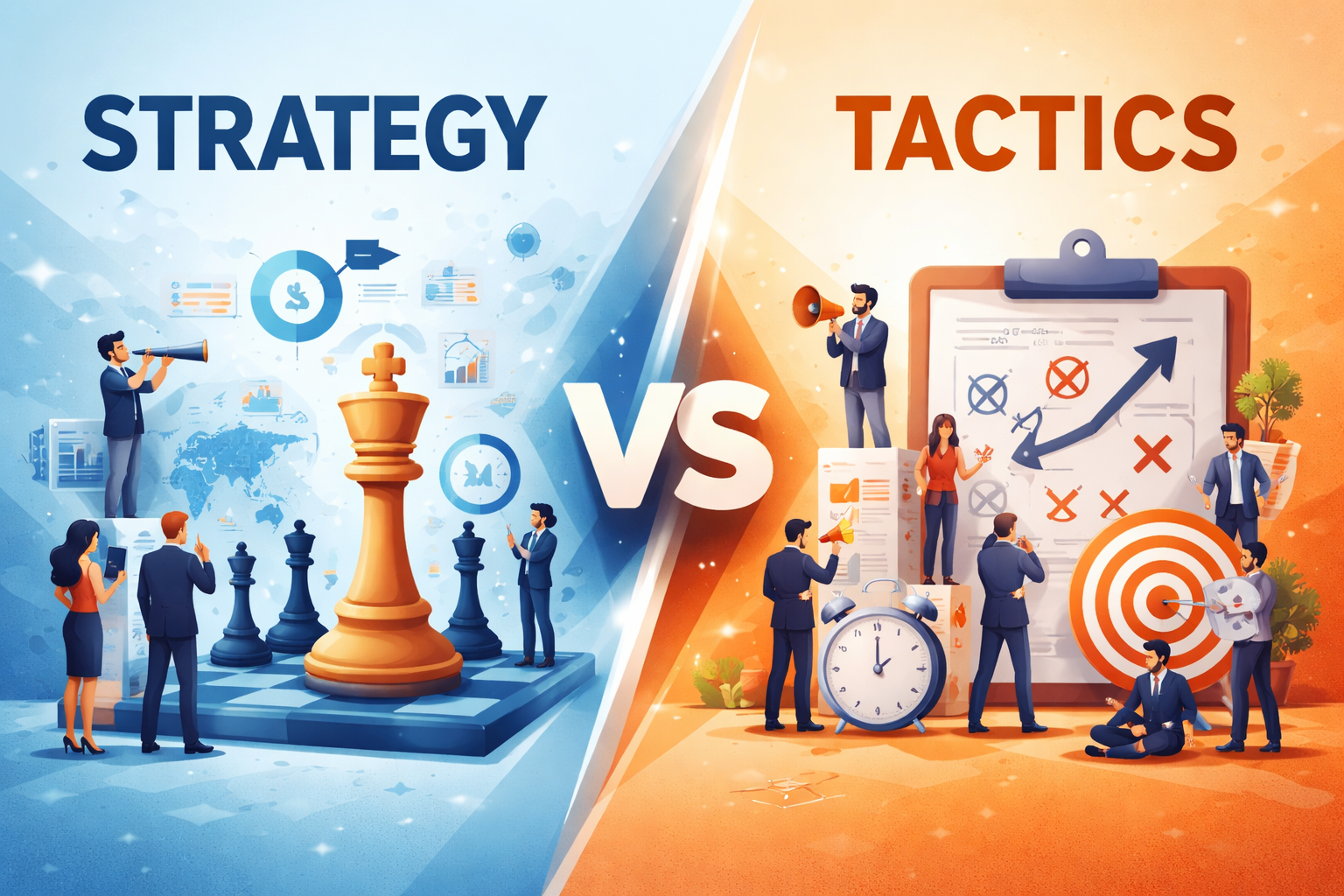
The real difference between strategy and tactics comes down to one question: are you deciding where to go, or how to get there? Most organizations conflate the two, and that confusion costs them years of misdirected effort.
A winning strategy is a small set of deliberate choices about where to compete and how to create competitive advantage over a multi-year horizon. It’s not a list of projects. Strategy sets the strategic direction by explicitly choosing what the organization will not do—the trade-offs that define positioning. Good strategy fits on one page with 3–5 choices and testable outcomes.
Tactics are the specific actions, marketing campaigns, process changes, and experiments executed over weeks or months to advance the chosen strategy. They’re about methods, channels, and sequencing within an established frame.
Consider a SaaS company deciding to focus exclusively on mid-market customers in the European Union. That’s strategy—it determines positioning, resource allocation, and what opportunities to decline. Running a LinkedIn ad campaign targeting HR directors in Germany? That’s a tactic. Similarly, a product launch is a tactical marketing activity that should align with the broader business strategy. A product launch on its own is not a strategy; it is a specific tactic that supports the organization’s long-term goals when executed within the context of a clear strategic direction.
When Slack chose to dominate the mid-market collaboration space between 2018 and 2022, that strategic choice drove 300% growth. The LinkedIn campaigns, product features, and sales scripts were tactics within that frame. Without the clear strategy, those same tactics would have scattered effort across incompatible customer segments.
Why Organizations Confuse Activity With Direction
Picture a typical 2025 leadership team: calendars are 90% full, dashboards track 47 different initiatives, and stand-ups happen daily. Yet when asked “What are we really trying to win at?” the answers vary wildly across the room.
Cognitive biases drive this confusion. Activity feels productive and controllable. You get dopamine hits from completing tasks. Strategic choices, by contrast, feel risky, political, and uncomfortable. They require saying no to opportunities and making irrevocable trade-offs. Research from behavioral economics explains why leaders cling to controllable short-term actions amid uncertainty.
Structural factors amplify the problem. Annual budgeting cycles reward detailed plans and headcount requests far more than clear positioning. A 2025 analysis found 65% of planning time spent on tactical line-items rather than strategic focus.
Culturally, many organizations equate responsiveness and “firefighting” with heroism. Tactical work is visible in stand-ups and dashboards. Strategic progress is quiet and takes years to materialize. The firefighter who solves today’s crisis gets celebrated; the strategist who prevented next year’s crisis goes unnoticed.
One insurer launched 40+ “innovation” micro-projects—AI chatbots, app tweaks, process improvements—without ever choosing a customer segment or clear differentiation path. The result: $50M burned annually with no measurable competitive advantage. Activity was abundant. Direction was absent.

Where Strategy vs Tactics Break Down in Planning
Annual and quarterly planning cycles are where most strategic confusion gets baked into organizational DNA. The 2026 planning season will repeat the same mistakes unless leaders intervene deliberately.
Strategic plans routinely devolve into 50-page project lists with dates and owners but no clear choices, trade-offs, or competitive logic. HBR case studies show 60% of Fortune 500 “strategic plans” are essentially project catalogs lacking any coherent positioning thesis.
The hierarchy becomes invisible when organizations mix 3-to-5-year goals and 90-day tasks on the same spreadsheet. A good strategy page shows 3–5 strategic choices with measurable outcomes. A bad strategy page lists dozens of detailed initiatives with no connecting thesis—no explanation of why these initiatives, why now, why in this sequence.
Common planning mistakes include treating revenue targets as business strategy (85% of firms do this), confusing themes like “digital transformation” with coherent strategic direction, and jumping straight from vision statements to project backlogs without the logic layer in between.
How Planning Meetings Turn Strategy Into Task Lists
The typical Q4 offsite agenda reveals the problem immediately: two hours on “strategic priorities” followed by six hours on initiative planning, owners, and timelines.
Executives skip the hard discussion of strategic choices. Instead, they spend 80% of meeting time wordsmithing initiatives. Every function fights to “get their project onto the roadmap.” The result is a negotiated to-do list masquerading as strategy.
The outcome: no clear sense of what would make the organization win, only a shared understanding of how busy everyone will be. Teams understand their tasks but can’t explain how those tasks connect to sustainable growth or competitive advantage.
The corrective is straightforward but uncomfortable: dedicate explicit time before any initiative discussion to clarify strategic hypotheses. “We will win by X with Y customers against Z competitors.” Only after alignment on that frame should tactical plans emerge.
Strategy vs Tactical Decision-Making In Daily Operations
Big-picture planning connects directly to day to day operations through thousands of small decisions made by managers and frontline teams focus across the organization.
Strategic decisions materially change where resources, attention, or positioning will be focused for multiple years. Exiting a market, changing a pricing model, or acquiring a competitor—these reshape the business forward. They require executive involvement and board-level discussion.
Tactical decisions optimize execution within the existing overall strategy. Pausing a specific marketing plan, adjusting a sales script, rescheduling production runs—these happen weekly and should be owned by the leaders closest to execution.
Without clear strategy, even small operational decisions become political. Sales teams in different regions make inconsistent choices about which customers to prioritize. Marketing campaigns pull in contradictory directions. Resources scatter across conflicting bets.
Netflix’s content strategy—investing in originals to drive retention—simplified countless operational decisions. When viewership data showed a show underperforming, the tactical decision to pause production was easy. The strategic intent was clear; tactical execution followed naturally. This clarity contributed to 20% margin improvement between 2019 and 2023.
Recognizing When Tactical Choices Are Masquerading as Strategy
Most organizations inflate tactical moves by labeling them “strategic initiatives.” This semantic inflation makes everything harder to prioritize.
Watch for these signals: “strategy” statements that mention specific channels (“our TikTok strategy”), tools, or campaigns instead of markets, problems, and value proposition clarity.
“We will increase social media posting frequency by 25%” is a tactic, not a strategy.
“We will become the default choice for first-time homebuyers in the UK by simplifying the mortgage journey” is strategy—it specifies a market, a customer segment, and a differentiated position.
Mislabeling tactics as strategy creates organizational confusion. When a tactic carries strategic weight, killing it becomes politically difficult even when data shows it’s not working. Decision making stalls as teams argue over which “strategic” initiative to cut.
A simple test: if it can be fully implemented in under six months and doesn’t materially change your positioning, it’s probably a tactic.
Why Tactical Work Dominates: The “Busy But Stuck” Trap
The pattern is unmistakable: teams feel overloaded, calendars overflow, yet core strategic KPIs—market share, margin, NPS—barely move year over year. Organizations confuse activity with direction and wonder why measurable results remain elusive.
Urgency drives the trap. Customer escalations, month-end targets, and operational fires crowd out strategic work. The urgent always defeats the important when there’s no clear direction to maintain focus.
Incentives reinforce tactical heroics. When 70% of bonuses tie to quarterly numbers, people optimize for short-term wins. Performance reviews celebrate the firefighter, not the architect.
Psychologically, checking off tasks provides comfort. Working on 18-month strategic shifts with delayed feedback creates ambiguity that humans naturally avoid.
One retail bank repeatedly postponed core-system modernization in favor of promotional offers and branch campaigns. Between 2022 and 2025, project volume rose 40% while profit per customer remained flat at $300. Activity increased. Progress on strategic objectives stalled.

The Cost of Tactical Overload on Strategy Execution
Tactical overload compounds over 2–3 years into measurable organizational damage that forces leaders to confront uncomfortable realities.
Innovation pipelines stall as teams maintain focus on immediate deliverables. Customer experience fragments across business units (one firm saw NPS variance of 15+ points across regions). Effort duplicates—internal benchmarks show 20% waste from redundant projects. Cross functional collaboration suffers as teams optimize their own metrics.
People effects accumulate: burnout rates rise (engagement scores dropped 12% in one BCG case study), cynicism spreads about “the strategy du jour,” and high performers leave for organizations with strategic clarity.
The data is stark: organizations that increased project count by 40% between 2022 and 2025 while revenue per employee flatlined have confused motion with making progress. The future belongs to organizations that recognize doing less, better, is a strategic decision—not a loss of ambition.
Connecting Daily Tactics to a Coherent Strategic Direction
Shifting from diagnosis to solutions requires explicit alignment between big choices and everyday work. Translating strategy into tactical actions isn’t automatic—it requires deliberate architecture.
The principle of “line of sight” matters: every team member should connect their weekly priorities to 1–2 strategic goals for 2026 and beyond. When teams understand how their work advances defined goals, engagement rises and vanity metrics lose their appeal.
A simple one-page strategy map shows how strategic objectives, initiatives, and KPIs relate. This isn’t bureaucracy—it’s clarity that enables faster tactical decisions by teams closest to execution.
Turn plans into 90-day outcomes, then into specific tactics with owners and timelines. Example flow:
Strategic choice: “Win mid-market customers in Germany”
90-day outcome: “Improve onboarding NPS by 15 points”
Tactical actions: Rebuild onboarding emails, adjust sales handover process, update training scripts
This cascade from north star to everyday work creates coherence without micromanagement.
Practical Ways to Keep Strategy Visible in Everyday Work
Visibility and repetition prevent strategic drift back into purely tactical behavior. Strategy that lives only in planning sessions dies in execution.
Embed strategic priorities into existing rhythms: weekly leadership check-ins, monthly business reviews, and performance one-to-ones. Start senior meetings with a 5-minute review of strategic goals. Tag major projects explicitly to strategic choices. Call out misaligned work when you see it.
Use a stable set of strategic KPIs (no more than 8–10) reported consistently over multiple years. Tactical metrics can flex quarterly; strategy execution metrics should not.
One firm shifted meeting agendas in 2024 to reserve time for strategic blockers and trade-offs rather than pure operational status updates. Within two quarters, teams reported clearer understanding of priorities and fewer conflicting requests.
Building the Right Balance Between Strategic Focus and Tactical Flexibility
The goal isn’t “more strategy, fewer tactics.” It’s the right proportion and sequencing between them. A strong strategy enables tactical flexibility, not rigidity.
An effective strategy gets refreshed every 12–18 months with formal review of big assumptions. Tactics adjust weekly or monthly in response to data. Strategy stability enables tactical experimentation.
A small number of strategic bets (3–5) executed consistently delivers more long term success than 20 disconnected initiatives. Holistic approach beats scattered effort.
Clear governance matters: document who can change the strategy, who can change tactics, and what thresholds trigger re-examination. A 10% drop in a key metric might warrant tactical adjustment; a fundamental market shift might require strategic review.
One company set a 3-year strategy (2024–2027) while running monthly experiments within that frame—changing channels, messages, and campaigns without changing core direction. They scaled 25% faster than competitors who constantly pivoted strategy.
Simple Tests to Check if You’re Over-Tactical or Under-Strategic
Self-diagnose your organization in under 10 minutes with these tests:
Ask five managers for the company’s strategy. If answers vary wildly (80%+ variance signals tactical overload), you have a communication problem or no real strategy at all.
Count active “strategic initiatives” versus full-time staff. A ratio greater than 1:1 suggests you’ve labeled everything strategic and therefore nothing is.
Review last month’s leadership meeting minutes. If 80% of time went to updates and 20% to strategic ambiguity, planning sessions need restructuring.
Each test reveals either over-emphasis on tactics (many disconnected projects, no shared story) or under-investment in strategy (no explicit trade-off decisions documented).
Treat results as a baseline. Commit to one specific change in the next planning cycle—even a small shift signals that right direction matters as much as activity.
Strategy, Tactics, and Competitive Advantage: Why It Matters
In today’s hyper-competitive business landscape, the distinction between strategy and tactics is more than academic—it’s the difference between organizations that achieve sustainable growth and those that simply stay busy. A well-crafted business strategy acts as the overarching plan, setting the strategic intent and defining the direction for the entire organization. Strategic plans are not just about setting ambitious goals; they are about making deliberate choices that position the business for long-term success and competitive advantage.
Effective strategy execution depends on translating strategic objectives into actionable tactics. This means every tactical decision—whether it’s launching a new marketing campaign, adjusting a product feature, or reallocating resources—must be anchored to the overall strategy. When teams focus solely on tactical actions without a clear strategy, they risk falling into tactical overload, where activity is high but progress toward defined goals is minimal. Most companies face this challenge, confusing motion with momentum and mistaking detailed plans for strategic thinking.
A winning strategy provides strategic clarity, forcing leaders to make tough trade-offs and prioritize what truly drives value. For example, a marketing plan that is not rooted in the organization’s value proposition or strategic goals can drain resources without delivering measurable sales growth or market share gains. On the other hand, marketing campaigns that are tightly aligned with strategic objectives become powerful levers for revenue growth and customer acquisition.
Tactics typically operate on shorter timeframes and must remain flexible to adapt to changing market conditions. However, without the guidance of a strong strategy, even the best-executed tactics can lead to fragmented efforts and missed opportunities. Strategic thinking ensures that day-to-day operations and tactical execution are always moving the business forward, not just reacting to immediate pressures.
To maintain focus and achieve sustainable growth, organizations must regularly measure progress against strategic KPIs—not just vanity metrics. This requires a holistic approach, where teams understand how their tactical decisions contribute to the overarching plan and long-term strategic goals. Strategic ambiguity is a common pitfall; when the connection between strategy and tactics is unclear, teams tend to drift, and decision making becomes reactive rather than proactive.
The future belongs to organizations that can make strategic choices, embrace necessary trade-offs, and maintain a clear direction even as they adapt their tactics. Good strategy is concise, actionable, and aligned with the company’s north star. Bad strategy, by contrast, leads to confusion, misalignment, and stalled progress.
Ultimately, competitive advantage is built on the ability to turn plans into reality—translating strategy into tactics that deliver results. By keeping the overall strategy visible, making tactical decisions that support it, and measuring progress with defined goals, organizations can stay ahead of the competition and achieve long-term success. The right balance of strategic focus and tactical flexibility is what separates organizations that thrive from those that merely survive.
FAQs
These FAQs address common practical questions about strategy vs tactics that leaders encounter when implementing the concepts above.
How often should we revisit our strategy without becoming reactive?
Core strategy—where to play, how to win—should be reviewed deeply every 12–18 months, with a lighter checkpoint each quarter. The annual offsite (e.g., Q4 2026) handles major decisions; quarterly reviews test assumptions; monthly reviews handle purely tactical adjustments.
Revisiting doesn’t mean changing. The default should be to test and reaffirm strategic choices unless data shows a clear need to pivot. Frequent tactical changes inside a stable strategic frame signal healthy adaptability, not confusion.
Who should be involved in setting strategy vs choosing tactics?
Strategy should be led by the CEO and executive team with meaningful input from key functions and front-line insights, but final decisions concentrated to avoid dilution. Bad strategy often results from trying to please everyone.
Tactics are best owned by leaders closest to execution—heads of sales, marketing, operations—within clear strategic guardrails. Document both levels so people across the organization understand who decides what.
How can we stop every project from being labelled “strategic”?
Create a simple rule: only initiatives that materially advance one of 3–5 strategic objectives for the next 3–5 years can be called “strategic.” Publish this list and require every proposed initiative to map explicitly to one objective.
Use different language internally—“run-the-business,” “improvement,” “strategic bet”—to prevent everything competing for the same label. This discipline makes it easier to stay ahead of tactical overload by saying no to misaligned work.
How do we communicate the difference between strategy and tactics to all staff?
Create a one-page explainer defining strategy and tactics in plain language with 2–3 organization-specific examples. Use consistent metaphors in town halls and meetings: “strategy is the destination; tactics are the steps on the route.”
Ask managers to open monthly team meetings by linking their team’s key actions to strategic goals. Over 6–12 months, this repetition builds shared understanding and reduces the tendency to confuse activity with direction.
What should we do in the next 90 days if we suspect we’re over-tactical?
Start with a brief diagnostic: list all major initiatives, group them under 3–5 strategic goals, and identify any that don’t clearly fit. You’ll likely find orphan projects consuming resources without strategic justification.
Pause or de-prioritize a small number of low-impact, misaligned projects to free capacity. Schedule a short strategy alignment session with leadership to restate core choices and agree which metrics signal progress by quarter-end. Even a few visible trade-offs in 90 days signals that strategic clarity now matters as much as activity.