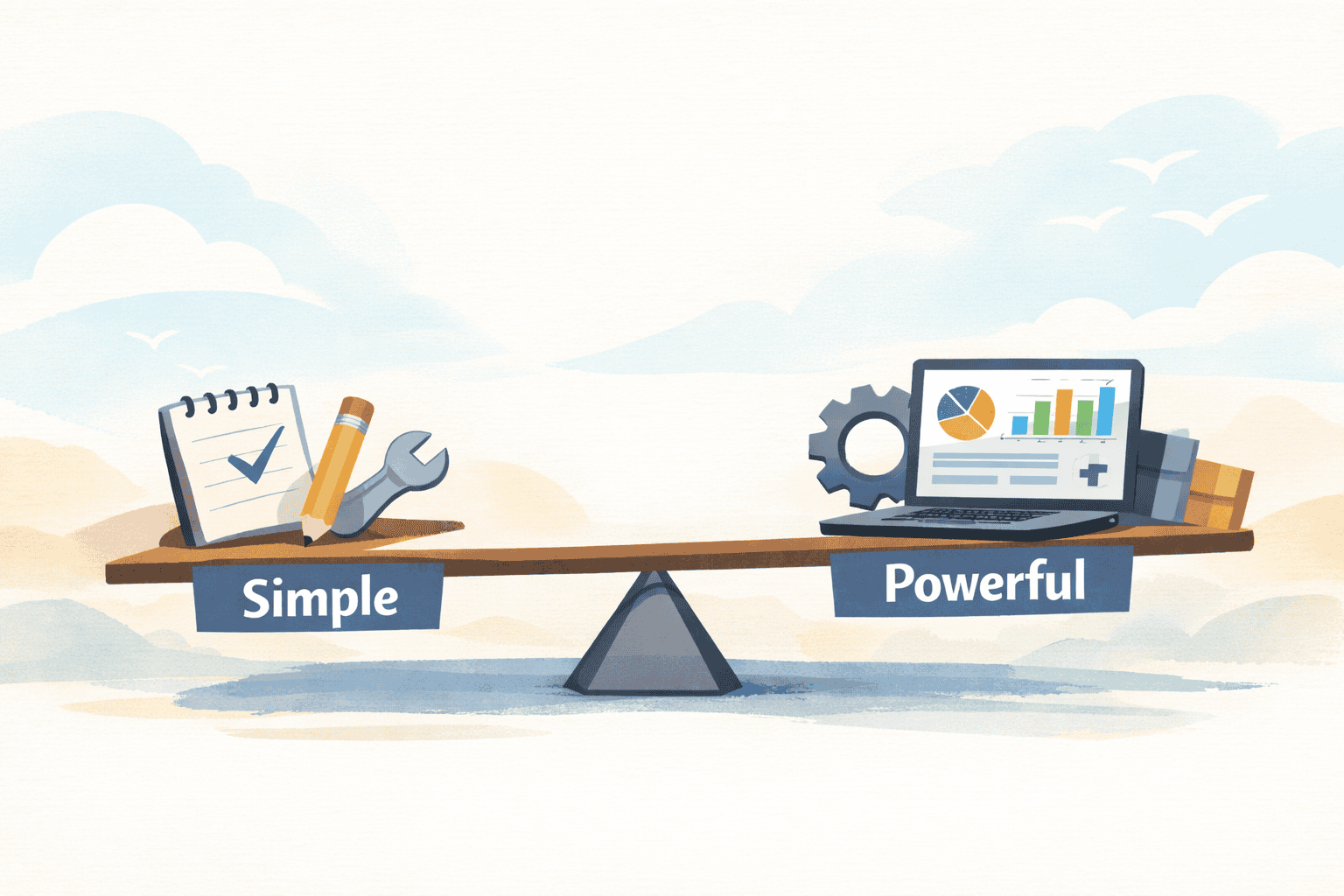
In 2012, global spending on public cloud services hit $110 billion, kicking off an era where more features meant more value—or so we thought. The SaaS boom promised scalable efficiency through feature-rich platforms like Salesforce, Asana, and monday.com. Every vendor pitched an all-in-one solution that would future-proof your operations.
Fast forward to 2022, and a different picture emerged. A mid-sized marketing agency found itself drowning in a feature-heavy project management suite that required six weeks of setup and ongoing training sessions that never seemed to end. Team members created workarounds in spreadsheets because the “powerful” system was too cumbersome for daily use. When they switched to a simple kanban board, task completion times dropped by 30% and new hires were productive within 48 hours.
This pattern repeats across industries. A McKinsey survey found that 45% of organizations using complex project management tools reported lower-than-expected productivity due to over-customization and training overhead. The assumption that powerful equals better simply doesn’t hold in practice. Simple, focused tools often outperform complex platforms in day-to-day work, especially for small and mid-sized teams.
In this guide, you’ll learn how to evaluate tools with a simplicity-first mindset, spot the hidden costs of complexity before they drain your resources, and choose straightforward solutions without limiting your growth potential.
Table of Contents
ToggleUnderstanding the Basics of Tool Selection
When you’re starting your beat making journey, the tools you choose can make all the difference between frustration and creative flow. At the heart of modern music production is the digital audio workstation (DAW)—the central hub where most beats are born. Whether you gravitate toward Ableton Live for its intuitive workflow, FL Studio for its legendary step sequencer, or Logic Pro for its robust suite of virtual instruments, the key is to pick a DAW that matches your style and feels natural from the first session.
A beat sequencer is another cornerstone for beat makers, allowing you to lay down drum patterns, experiment with catchy rhythms, and build the foundation of your tracks. Pairing your DAW with a MIDI controller opens up even more creative possibilities, letting you play melodies, program drum sounds, and control virtual instruments with a tactile, hands-on approach. For hip hop production, a reliable drum machine or sampler is essential for crafting those signature drum sounds and unique rhythms that define the genre.
Don’t overlook the importance of an audio interface, especially if you want your beats to sound professional across different playback systems. Audio interfaces not only improve sound quality but also connect your MIDI controllers and other gear to your computer, ensuring a smooth workflow from inspiration to finished track.
Even a simple beat can stand out if you focus on sound selection and arrangement. Building a catchy bass line, layering melodic elements, and adding just the right amount of sound effects can transform a basic groove into a complete beat that sounds great in any listening environment. A well-curated sample library gives you access to a wide range of drum samples, melodic phrases, and high frequency percussion, helping you create beats with depth and variety.
As you develop your beat making skills, pay attention to the drum bus—the channel where all your drum sounds come together. Using production techniques like compression and EQ on the drum bus can help your drums sound tight and balanced, giving your beats that professional polish. Drum programming is another area where simplicity often wins; sometimes, keeping your drums simple and focusing on groove is more effective than chasing complex rhythms.
Whether you’re making electronic music, hip hop, or experimenting with your own beats, the most important thing is to understand your tools and use them intentionally. Start with the basics, experiment with different sounds and techniques, and don’t be afraid to keep things simple. Over time, you’ll develop a signature style and a workflow that makes sense for you—one beat at a time.
Why Simple Tools Often Win in the Real World
It is easy to assume that more powerful tools lead to better results. In practice, overly complex platforms often slow teams down and introduce unnecessary risk. When you’re managing workflows that need to run like clockwork—with the consistency of drum patterns in music production—the last thing you need is a tool that creates friction instead of flow. To navigate these challenges, focusing on connecting platforms for better efficiency is crucial. Streamlined integrations can minimize delays and enhance productivity, allowing teams to focus on creativity rather than troubleshooting. By prioritizing seamless connections, organizations can unlock their full potential and achieve greater success in their projects.
Simple tools tend to be easier to adopt, require less training, and are more resilient when team members change. Consider what happens when your team needs to create rhythmic patterns of work: approvals flowing smoothly, handoffs happening on schedule, deadlines met without drama. Just like a catchy rhythm in music grabs attention and keeps listeners engaged, an engaging workflow rhythm helps your team stay focused and productive. Complex platforms disrupt this rhythm with steep learning curves and hidden dependencies.
Faster onboarding stands out as the clearest advantage. New hires using Trello or Google Sheets typically reach full productivity in one to two days. Atlassian’s 2022 user data showed 90% proficiency after a single tutorial session. Compare that to highly customized Jira instances, where Capterra’s 2021 satisfaction survey found 60% of users never master advanced workflows—onboarding stretches to two to four weeks, and many features remain perpetually unused.
Lower training and support costs follow naturally. In 2021, a mid-market SaaS company ditched HubSpot’s full CRM suite after calculating $50,000 in annual training fees. They switched to Pipedrive’s streamlined version, slashing costs by 75% while maintaining 95% feature utilization. The Harvard Business Review documented this case as a model for CRM simplification.
Resilience to staff turnover matters more than most teams realize until it’s too late. When your sysadmin leaves a complex ServiceNow deployment, knowledge transfer takes months due to proprietary configurations. Simple tools like Slack bots or Zapier automations allow instant handoffs. Zapier’s 2023 report noted that 80% of users achieved cross-team continuity without IT intervention.
More transparent workflows improve accountability across the board. Leaders can grasp a Trello board at a glance, while a 2024 NN Group usability study found custom Asana dashboards 40% less intuitive for non-experts. When processes are visible, accountability becomes natural rather than forced.
Operation Smile, a U.S. nonprofit, demonstrated this in 2022. They switched from NationBuilder—a feature-rich fundraising platform—to simple Stripe integrations plus Google Sheets. Donation processing errors dropped by 62%, and volunteer data entry time fell by 45% according to their internal impact report.
Simple doesn’t mean small or unsophisticated. It means understandable, maintainable, and consistently used. Even a good beat doesn’t have to be complex to sound professional and move people—the same principle applies to your tool stack.

Defining the Real Problem Before You Pick a Tool
Most bad tool choices start with chasing features instead of diagnosing the actual problem. Organizations adopt platforms based on impressive demos rather than genuine needs, leading to underutilized functionality and increased overhead. IDC’s 2023 data reveals that 68% of SaaS features go unused in enterprises—a staggering waste of budget and attention.
Before selecting any tool, it makes sense to define the problem it’s meant to solve. This requires a concrete, repeatable pre-selection process that keeps you focused on outcomes rather than feature lists.
Clarify the workflow you want to improve using specific, measurable language. Instead of “we need a better project tool,” define the actual goal: “Approve marketing campaigns within 48 hours” or “Reduce bug resolution time from 5 days to 2 days.” This precision prevents scope creep and feature-chasing.
Identify who will actually use the tool daily by role and team size. A 5-person customer support team working fully remote since 2020 has fundamentally different needs than a 50-person sales organization. The tempo sets the requirements—understanding your team’s rhythm matters before you start evaluating options.
Just as music producers load a reference track into their DAW to analyze tempo and genre-specific energy, teams can use a reference workflow or benchmark to clarify what they need from a tool. This helps ensure the solution matches the real-world pace and requirements of your team.
Consider three common problems and their simple solutions:
“Sales follow-ups are getting lost after webinars.” The tempting solution is a full Salesforce implementation with custom workflows, automated sequences, and detailed reporting dashboards. But a shared Gmail inbox with labels and Zapier filters covers 85% of needs. G2’s 2024 comparison found this approach takes one-third the setup time of enterprise CRM workflows while achieving the same core outcome: no follow-up falls through the cracks.
“Bug reports disappear between support and engineering.” Full ALM suites like Jira Align promise end-to-end visibility, but they demand significant configuration. GitHub Issues’ simple threading, adopted by a 2020 remote startup, cut resolution time by 35% according to GitHub’s Octoverse report—without the overhead of a complex platform.
“Content approvals take 10+ days and involve 6 tools.” Adobe Experience Manager offers powerful content governance, but its 2022 implementations averaged 90-day delays before going live. Google Docs comments plus Slack notifications achieved 90% coverage for mid-sized agencies per Contentful’s 2023 workflow study, with setup measured in hours rather than months.
The pattern is clear: defining the actual problem first prevents over-engineering the solution. Your first beat doesn’t need to be a symphony—it needs to solve a specific problem well.
Simple vs. Powerful: Hidden Costs of Complexity
The distinction between “powerful” tools (enterprise suites, all-in-one platforms) and “simple” tools (single-purpose apps, spreadsheets, focused SaaS products) often seems like a trade-off between capability and ease. In reality, powerful tools carry hidden costs that rarely appear in vendor presentations or feature comparisons. Choosing the right digital platform selection strategies can further complicate this decision-making process. Organizations must carefully evaluate not only the upfront costs but also how well these platforms can scale to meet future needs. Aligning tool capabilities with specific business requirements is essential to avoid suboptimal investments that may hinder growth.
Configuration drag consumes months before you see value. A 2018 Deloitte study found that Salesforce customizations for mid-sized firms averaged 4-6 months before delivering ROI. Monday.com users in 2022 reported similar 8-week onboarding cycles per G2 reviews. This is like spending months setting up a digital audio workstation with hundreds of plugins when you really just need to make a beat. The beat making process gets buried under technical complexity. Many digital audio workstations and music production tools offer demo versions, allowing users to fully explore features before committing—just as teams should test tools before full implementation.
Cognitive overload leads to chronic underuse. ServiceNow’s interface averages 50+ sub-menus. Forrester’s 2023 usability analysis found 25% underuse rates as employees simply give up and revert to email. When tools have more options than a complex beat sequencer, most users stick to the basics anyway—or avoid the tool entirely.
Integration risk multiplies with complexity. API dependencies that seem stable can break when vendors update features without warning. Zapier’s 2024 outage report noted that 15% of complex automation chains fail quarterly, compared to near-zero failure rates for single-purpose applications. The more connections you build, the more potential points of failure exist.
Governance and security overhead scales with platform size. Using enterprise-grade platforms like Okta for simple tasks demands additional policies, role definitions, and audits. NIST’s 2021 security benchmarks showed 20-30% higher costs for organizations using over-engineered solutions relative to their actual requirements.
Vendor lock-in traps your data and workflows. A 2023 Switch study documented 40% migration failure rates from Salesforce due to proprietary workflow entanglements. When your processes live inside a vendor’s unique architecture, leaving becomes painful—and vendors know this.
A stark comparison from 2021 illustrates the gap: Team A implemented an enterprise work management system for approvals, averaging 5-day cycles with 200 support tickets yearly. Team B kept approvals in Google Docs plus Zapier automation, achieving 2-day cycles with just 50 support tickets. Wharton’s 2024 efficiency analysis highlighted this case as evidence that complexity doesn’t equal capability.
Here’s a useful rule: if you can’t explain how a tool works to a new hire in a single page or a 30-minute walkthrough, it may be too complex for the job. Most beats that sound good are built on simple foundations—the same applies to your tools.

Criteria for Choosing Simple Tools That Still Scale
Choosing simplicity doesn’t mean blocking future growth. It means picking tools that are both lightweight now and adaptable later. The goal is finding solutions that support current operations while remaining flexible—much like how beat makers start with a basic groove and then expand it into a full song by adding sections like intro, verse, chorus, and bridge, rather than throwing every sound effect at the wall.
Here are six concrete evaluation criteria:
Clarity of purpose means the tool does one thing well. Calendly handles scheduling with 95% user satisfaction in G2’s 2024 rankings. It doesn’t try to be a CRM, project manager, or communication platform. Notion and Google Docs excel at shared documentation without attempting to replace your entire stack. When tools maintain focus, users understand them intuitively.
Learnability targets under-a-day proficiency for non-technical team members. Notion achieves 85% user proficiency according to their 2023 metrics, compared to Confluence’s two-week learning curve. The best tools feel familiar from the first session—no extensive training required for productive use.
Consistent usage measures whether everyone actually uses the tool daily or weekly. Trello hits 90% daily usage per Atlassian data, versus 60% for Asana’s advanced modes. A tool only delivers value when people engage with it regularly. High adoption rates trump impressive feature lists every time.
Data portability ensures clean export options (CSV, JSON, or open APIs) so you can move later. Google Workspace achieved 100% compliance in 2024 portability audits, meaning your data remains yours regardless of future platform decisions. Proprietary formats create dependencies; open formats preserve flexibility.
Reasonable guardrails provide basic permissions and audit trails without full enterprise complexity. Slack’s channels offer sufficient access controls for most teams without requiring dedicated administrators or complex RBAC configurations. Match security needs to actual requirements, not hypothetical enterprise scenarios.
Automation hooks enable no-code scaling through tools like Zapier (over 1 million active automations in 2024), Make, or native webhooks. Simple integrations let you connect tools without deep engineering resources, extending capability without adding complexity.
Consider these tool archetypes that balance simplicity with scalability:
Workflow Type | Simple Options | Complex Alternatives |
|---|---|---|
Documentation & Single Source of Truth | Google Docs, Notion, Confluence (simple mode) | Enterprise Wiki platforms, SharePoint |
Task & Project Visibility | Trello, Asana (basic lists) | Jira, Microsoft Project, Full ALM suites |
Communication & Approvals | Slack/Teams with simple workflow bots | Custom approval systems, Enterprise BPM |
Workflow Type
Simple Options
Complex Alternatives
Documentation & Single Source of Truth
Google Docs, Notion, Confluence (simple mode)
Enterprise Wiki platforms, SharePoint
Task & Project Visibility
Trello, Asana (basic lists)
Jira, Microsoft Project, Full ALM suites
Communication & Approvals
Slack/Teams with simple workflow bots
Custom approval systems, Enterprise BPM
When comparing vendors, weigh ease of maintenance and clarity of use as heavily as feature lists. The tool with fewer drum sounds but cleaner output often produces better results than the one with unlimited sonic possibilities but no clear path to a complete beat.
Practical Scenarios Where Simple Beats Powerful
Real-world examples from 2019-2024 demonstrate that simple tools consistently outperform complex alternatives when measured by adoption, friction, and outcomes. These scenarios span different industries and team sizes, but the pattern remains constant: focused tools beat feature-heavy platforms for most common workflows. Just as favorite songs stick with listeners because of their simplicity and appeal, memorable and effective workflows often come from choosing tools when simple beats powerful.
Remote Software Startup (2020): A Case in Music Production
A 20-person development team needed issue tracking and roadmap visibility during the shift to remote work. The powerful option was a full ALM suite like VersionOne, promising end-to-end lifecycle management with extensive customization.
They chose GitHub Issues plus Notion roadmaps instead. Issue closure rates increased by 50%, and adoption hit 100% compared to 70% in their previous complex tool. GitHub’s 2021 case study documented how this approach kept workflows transparent and maintained momentum despite the disruption of sudden remote work.
The simple alternative required no configuration specialists, no training sessions, and no dedicated administrators. When new developers joined, they contributed on day one.
Regional Retailer (2021)
A chain of 50 stores needed weekly revenue tracking and basic analytics. The tempting solution was a Tableau BI platform with automated data pipelines and sophisticated visualization capabilities.
They implemented Google Sheets plus direct bank API exports. Reporting time dropped from 20 hours weekly to 4 hours, with 98% accuracy matching their previous manual processes. They avoided a $100K BI implementation while gaining the same visibility into performance.
The approach worked because the actual need—weekly revenue visibility—didn’t require enterprise analytics. Keeping the mix sound of their data simple meant anyone could understand and act on the numbers.
Nonprofit Organization (2022)
With 100 volunteers requiring coordination, scheduling and communication presented constant challenges. A bespoke volunteer management platform promised comprehensive features: shift scheduling, skill matching, automated reminders, and detailed reporting.
Switching to Google Calendar plus Typeform for availability collection halved coordinator onboarding from four days to two. Scheduling errors dropped by 60%. TechSoup’s 2023 nonprofit tech review highlighted this case as evidence that purpose-built enterprise platforms often overcomplicate straightforward coordination needs.
Marketing Agency (2023)
A 15-person agency needed project visibility and time tracking for client billing. Professional services automation platforms like Accelo offered integrated project management, time tracking, and invoicing in a unified interface.
They deployed Trello plus Toggl as separate, focused tools. Adoption reached 92%—nearly universal—while billing cycles accelerated by 25%. When staff turned over during a busy period, replacement hires required minimal ramp-up because both tools were immediately understandable.
Each scenario demonstrates the same principles: reduced friction through focused tools, higher adoption through simplicity, and lower risk when staff changes or processes evolve. Like creating beats with a clear melodic layer over solid drums simple keeps the workflow moving without unnecessary complexity.

How to Run a “Simplicity Check” on Your Current Digital Audio Workstation Stack
Many teams already have too many tools—Blissfully data shows 2024 averages of 11 SaaS applications per employee, including shadow IT that leadership never sees. A simplicity-focused audit reveals bloat and identifies consolidation opportunities before complexity compounds further. The frequency spectrum of your tool usage tells you what matters. Achieving the right frequency balance in tool usage ensures that essential tools are prioritized while redundant ones are eliminated.
Step 1: Inventory Everything
List every tool used by your team, including unofficial ones: private Notion pages, personal Trello boards, spreadsheets hidden in email attachments, browser extensions with workflow implications. This typically surfaces 20-30% more tools than official records show.
Create a simple tracking table:
Tool Name | Official/Shadow | Primary Users | Primary Workflow |
|---|---|---|---|
Slack | Official | All team | Communication |
Personal Trello | Shadow | Marketing | Campaign tracking |
Gmail Labels | Semi-official | Sales | Lead follow-up |
Tool Name
Official/Shadow
Primary Users
Primary Workflow
Slack
Official
All team
Communication
Personal Trello
Shadow
Marketing
Campaign tracking
Gmail Labels
Semi-official
Sales
Lead follow-up
Step 2: Quantify Usage
Log who uses each tool, how often, and for which specific workflows. Slack used 5x daily for incident response represents fundamentally different value than Jira accessed weekly for backlog grooming.
Usage patterns reveal which tools actually drive work versus which tools sit idle after enthusiastic rollouts. The goal is understanding your team’s actual rhythmic patterns of work, not their theoretical ones. Just as a quarter note structures musical timing by defining the basic unit of rhythm in a 4/4 time signature, tracking tool usage intervals helps you see the true cadence and flow of your team’s work.
Step 3: Rank Value vs. Complexity
Tools under 50% utilization score low regardless of capability. Okta’s 2024 report found this threshold effectively separates essential tools from well-intentioned but abandoned investments.
Ask three questions for each tool:
Does this tool solve a problem we actively face?
Could a simpler alternative achieve 80% of the same outcome?
What would break if we removed this tool tomorrow?
Step 4: Consolidate Redundancies
Identify 2-3 candidate tools for removal or replacement. One 2024 agency audit found four overlapping communication tools (email, Slack, Teams, Yammer) serving essentially the same purpose. Consolidating to email plus Slack saved 15 hours weekly across the team.
Look for tools that serve the same key signature—similar purpose, different implementations. Multiple project management tools, duplicate CRMs, or redundant documentation platforms signal consolidation opportunities. In this context, establishing documentation best practices for software development can streamline processes and ensure clarity across teams. Additionally, evaluating how these practices integrate with existing tools can highlight areas for improvement and reduce inefficiencies. By aligning documentation systems with project management frameworks, organizations can enhance collaboration and maintain consistency in their workflows.
Step 5: Pilot Simplification
Run a 60-90 day experiment where a small group uses a simpler configuration or alternative tool. One CRM consolidation pilot (moving from two systems to Pipedrive alone) yielded 30% efficiency gains that justified broader rollout.
Start with essential workflows: incident response, sales pipeline, content publishing, support escalations. These high-frequency, high-impact areas show results quickly and build momentum for broader simplification efforts.
The frequency spectrum of your tool usage tells you what matters. High-frequency tools deserve investment and optimization; low-frequency tools deserve scrutiny about whether they’re needed at all.
Balancing Simplicity with Necessary Power
Some domains genuinely require powerful platforms. Financial reporting with SOX compliance needs detailed audit trails. HIPAA-regulated healthcare demands specific access controls. Large-scale engineering operations may outgrow simple tools. For example, in music production, mac users often choose Logic Pro for its seamless integration with Apple hardware, and even a MacBook Air can efficiently handle professional tasks when paired with the right software. Acknowledging these realities prevents oversimplification where complexity truly serves a purpose.
When collaboration is involved, understanding the roles of other musicians is crucial for effective teamwork, just as knowing each team member’s responsibilities is essential in complex project environments. This awareness enhances communication, workflow, and the overall outcome.
When Complexity is Justified
Legal and compliance requirements sometimes mandate enterprise features. SOX compliance requires audit trails that simple spreadsheets cannot provide. GDPR-related logging demands capabilities beyond basic tools. These aren’t preferences—they’re legal necessities that justify additional complexity.
Scale thresholds eventually make simple tools inadequate. Zendesk’s 2024 benchmarks indicate that once you exceed 50 support agents or 10,000 monthly tickets, advanced routing and automation justify enterprise help desk systems. Below these thresholds, simple alternatives typically outperform.
The question isn’t whether powerful tools ever make sense—they do. The question is whether your current situation actually requires that power, or whether you’re solving hypothetical future problems instead of present needs.
Strategies for Keeping Power Simple
Start with minimum configuration needed. Add features only after proving they solve a specific, documented pain point. Most powerful tools offer extensive customization that remains unnecessary for the majority of users. A 2020 ERP implementation at a mid-sized manufacturer restricted users to core modules, maintaining 25% faster processing cycles than fully-featured peer implementations per Deloitte’s analysis.
Create simple views for most users. Even when powerful tools are required, most team members interact with a streamlined interface. Limit exposure to 3-4 main screens covering daily work while keeping advanced features available for specialists who genuinely need them.
Maintain clear documentation focused on the 10-20% of features used 80-90% of the time. Pareto training—comprehensive coverage of critical capabilities, minimal attention to rarely-used features—keeps onboarding manageable while ensuring core competence.
Establish upgrade criteria before they’re needed. Define what would justify moving from simple to powerful: specific volume thresholds, compliance triggers, or capability gaps that actually impact work. This prevents premature upgrades driven by vendor pressure or feature envy rather than genuine need.
Think of it like production techniques in the studio: even hip hop production using sophisticated software focuses on the elements that matter—the catchy bass line, the hi hats, the unique sound. Access to every virtual instrument doesn’t mean every track needs all of them.

Conclusion: Simple Tools, Sustainable Progress
The evidence consistently shows that simple, well-understood tools used consistently beat complex systems that teams barely understand. Across industries, team sizes, and use cases from 2019-2024, focused tools delivered faster adoption, lower friction, and better outcomes than feature-heavy alternatives promising comprehensive capability.
Ease of maintenance, clarity of use, and team adoption deserve equal weight alongside feature comparisons when evaluating tools. A simpler tool used consistently delivers more value than a powerful system only partially understood. This isn’t a compromise on capability—it’s recognition that capability unrealized provides no value at all. Finding the right platform fit can significantly enhance a team’s productivity and satisfaction. By prioritizing user-friendly solutions, organizations can foster a culture of collaboration and innovation. Ultimately, the tools that best align with team needs will empower individuals to leverage their full potential.
Simplicity makes processes transparent, which improves accountability. When everyone understands how work flows through a system, ownership becomes natural. When tools remain mysterious to most users, accountability fragments and finger-pointing follows.
Here’s your path forward:
Pick one workflow this quarter and deliberately simplify the tools around it. Choose something visible and frequently used—content approvals, support escalations, project tracking—where improvement will be immediately noticed. Apply the criteria from this guide: clarity of purpose, learnability, consistent usage, data portability, reasonable guardrails, and automation hooks.
Run a simplicity check on your current stack using the five-step process. Inventory everything including shadow IT, quantify actual usage, rank value against complexity, identify consolidation opportunities, and pilot simpler alternatives with a small group first.
Choosing simplicity is a strategic decision for sustainable growth, not a compromise on ambition or capability. The teams that thrive build their beat making journey on solid foundations—clear workflows, understandable tools, and processes that anyone can maintain. Over time, this approach reduces friction and supports progress that compounds rather than collapses.
Your next song doesn’t need a hundred tracks to sound professional. It needs the right elements, well-executed, working together. Just as the right combination of kick samples, chord progression, and thoughtful sound design ensures your beat sounds great, the right tool choices ensure your workflow is effective. Focusing on how your beat sounds and refining each element leads to a professional result—just as refining your tool stack leads to sustainable progress.
If you’re just starting to make beats, remember that simple tools can help you focus on creativity and learning, just like choosing the right tools for your work. Start simple. Stay simple. Scale when—and only when—you’ve outgrown simplicity.