Table of Contents
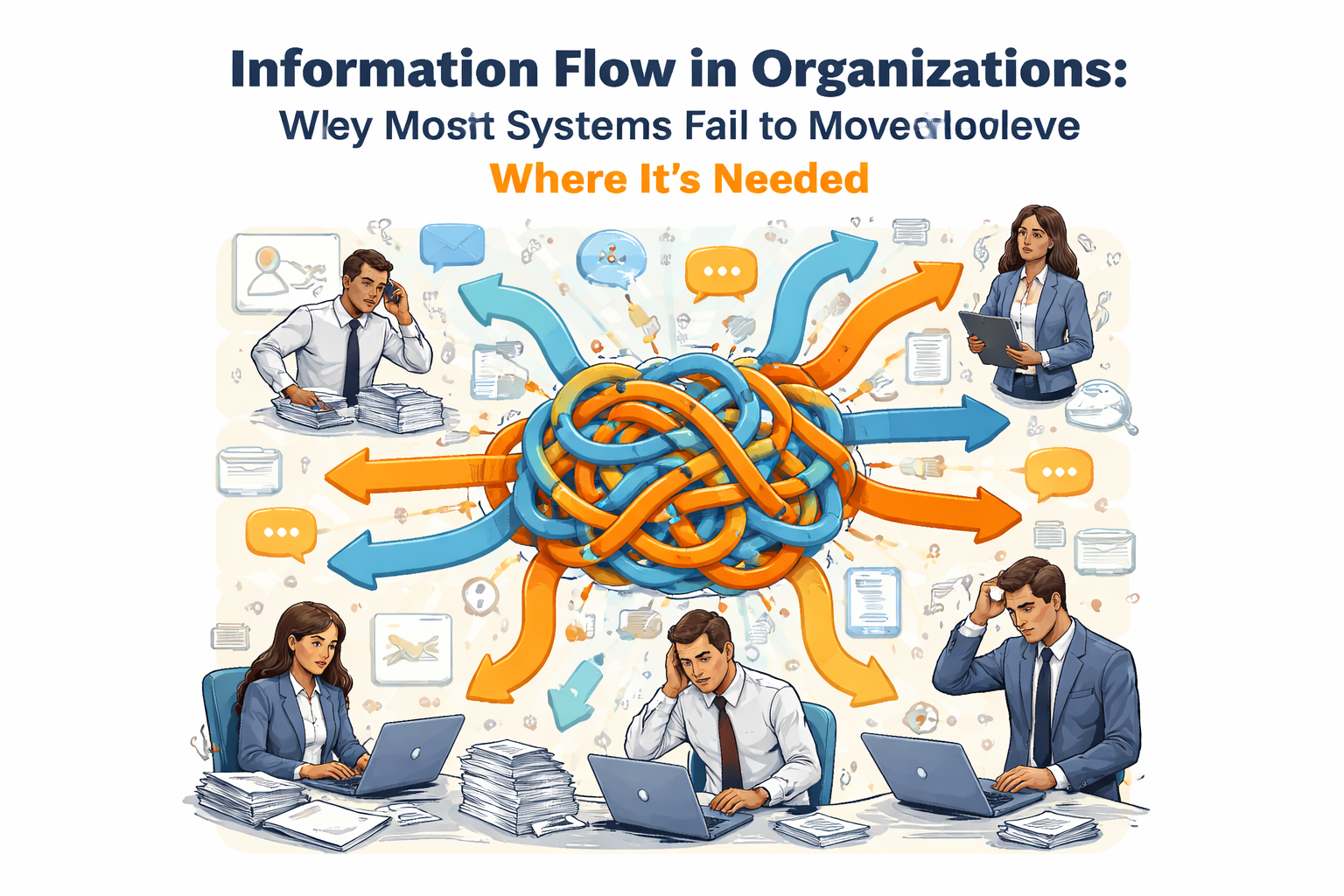
ToggleInformation Flow in Organizations: Why Most Systems Fail to Move Knowledge Where It’s Needed
Key Takeaways
Most organizations aren’t suffering from a lack of data—they’re suffering from knowledge that never reaches the people, moments, and decisions where it actually matters. The information exists; it just can’t be used.
Information flow failure is primarily about culture, incentives, and workflow design, not about missing the right tool. Organizations with excellent knowledge repositories still experience poor flow when behavioral factors go unaddressed.
Real-world failure patterns from 2013–2021 large IT rollouts reveal consistent breakdowns: training decks that don’t transfer capability, tacit knowledge trapped in silos, mismatched mental models between senders and receivers, structural bottlenecks at team interfaces, and incentives that reward secrecy.
Fixing information flow requires changing how decisions are made, how people are rewarded, and how knowledge is embedded into daily work—not just better documentation or another platform.
This article concludes with practical guidance on where to start, how to measure flow, and what role technology can realistically play.
Introduction: When Knowledge Exists But Can’t Be Used
In 2022, a mid-sized manufacturer faced a product recall that damaged both revenue and reputation. The frustrating part? Frontline technicians had flagged the defects in internal systems weeks earlier. Those signals existed in tickets, logs, and shift reports—but they never reached executives before the public failure.
By 2025, most mid-to-large organizations have terabytes of reports, dashboards, and wikis. Yet they still miss obvious risks and repeat the same mistakes. The problem isn’t missing information. It’s that stored data and actionable knowledge are two different things. Actionable knowledge means the right people understand and trust the right information at the right time, and that the information’s relevance is maintained—ensuring it is up-to-date and aligned with current needs. When decisions are made with incomplete information, it leads to poor data, resulting in bad business choices.
The cost is staggering: knowledge workers spend approximately 20–30% of their time searching for or recreating information that already exists within their organization. That’s nearly two days per week lost to broken information flow. Information flow in organizations refers to the systematic exchange of data, knowledge, and insights among people, processes, and technology.
This article analyzes the systemic reasons flows break down and offers a practical redesign playbook—not generic “communicate more” advice.

The Illusion of Flow: Why More Channels Don’t Mean Better Knowledge Movement
Walk into any enterprise in 2024 and you’ll find Slack or Teams, email, SharePoint or Confluence, ticketing tools like Jira or ServiceNow, and multiple BI dashboards. Yet somehow, the same questions still get asked in every meeting.
This is the illusion of flow. Leaders see high activity—messages sent, tickets closed, dashboards updated—and assume knowledge is actually reaching decisions. It’s not.
The real issue is what we might call “un-acted information”: data that is technically available somewhere but absent from the actual decision points. Consider a 2019 cloud migration where risk logs were diligently documented in Jira. Those logs never surfaced to the steering group. The result was an expensive outage that could have been prevented. To address this, organizations must ensure comprehension through systematic processes, feedback, and measurement, not just provide information.
The distinction matters:
Broadcasting information means flooding channels with reports, hoping someone relevant sees it
Designing for comprehension, ownership, and action means embedding context-specific insights directly into decision workflows, with named stewards who curate and validate knowledge domains
Activity metrics create comfort. Decision-quality metrics reveal truth.
Root Causes: Why Information Dies Before It Reaches Decisions
Most failures arise from interacting cultural, structural, and cognitive factors rather than a single root cause. Research identifies six critical failure factors inhibiting sharing: staff churn, limited time availability, unclear goals, lack of leadership encouragement, ill-formalized processes, and organizational ignorance where failures go underreported.
Let’s examine several factors that consistently kill information before it reaches decisions.
Fear and blame culture. Employees learn from past incidents that raising early warnings leads to punishment. After a 2018 cost overrun post-mortem turned into a blame session, teams learned to bury signals in low-visibility channels. This creates a bias toward success narratives over honest reflection.
Hierarchy and filtering. Information gets “polished” at each management layer. By the time it reaches a VP, all uncertainty and bad news have been removed. Critical nuances vanish in the journey upward.
Overload and signal-to-noise. Too many CC emails, reports, and dashboards without explicit prioritization frameworks cause people to skim or ignore updates entirely. When everything is flagged as important, nothing is.
Ambiguous ownership. No one is clearly responsible for curating and routing specific categories of knowledge. Messages about operational risk or customer feedback drift in shared inboxes with no clear steward.
The expert curse. Specialists document systems using jargon and abstractions that make sense to them but confuse new joiners and non-technical stakeholders. Procedural knowledge gets locked behind incomprehensible language.
Failure Pattern 1: Training Decks Without Transfer of Capability
Organizations frequently equate “sending a deck” or scheduling a webinar with actual knowledge transfer. This assumption consistently fails.
Large enterprise rollouts between 2013–2023—ERP, CRM, EHR, and core banking platforms—show a persistent gap between training completion rates and on-the-job performance. Project teams compress training sessions into a few days before go-live due to schedule pressure. The forgetting curve kicks in: up to 70% of new information is lost within 24 hours without reinforcement.
Consider a 2019 CRM rollout where sales teams aced e-learning quizzes but continued mislogging opportunities for months afterward. Pipeline forecasts were distorted because the new system wasn’t actually understood—just technically “trained.”
The core problem isn’t content quality. It’s the absence of:
Spaced repetition and reinforcement
Real scenarios that match actual work
Feedback loops that catch misunderstanding early
Embedding learning into daily workflows
Training sessions that exist outside the workflow rarely create lasting capability.
Failure Pattern 2: Tacit Knowledge Trapped in Silos and Individuals
Tacit knowledge is the experience-based judgment behind decisions—how a senior underwriter reads between the lines of a client file, or how a plant operator listens for abnormal machine noise. Systems capture transactions but not the rationales, edge cases, or informal workarounds that make processes actually work.
In 2021, a specialist left a utility company with 15 years of grid operations insights that were never codified. The result was repeated troubleshooting delays as colleagues rediscovered solutions the departed expert had internalized.
Departmental silos compound this problem. Operations, customer service, and risk teams develop local “fixes” invisible to others. Parallel teams repeatedly solve the same problems without knowing solutions already exist.
Simply mandating that people “document more” fails. Knowledge retention requires building documentation into performance metrics and workflow design—making the capture of valuable insights part of the job, not an afterthought.
Failure Pattern 3: Mismatched Mental Models Between Senders and Receivers
Even technically correct information fails when senders and receivers have different mental models of how the business works. This creates knowledge gaps that go unnoticed until problems surface.
Process experts or external consultants design documentation using abstractions that don’t align with frontline reality. SAP process diagrams look logical in design workshops but clash with how branch staff actually serve customers. In healthcare settings, documented system steps ignored real-time constraints like patient queues. In retail, procedures assumed steady flow when peak hours demanded completely different approaches.
These mental model mismatches show up as “users are resistant” complaints. In reality, employees are signaling that the documented process doesn’t fit their environment. They’re not resisting change; they’re flagging incomplete information.
This problem often surfaces months after a new system launches, when metrics like task completion times and error rates diverge sharply from business case assumptions.
Failure Pattern 4: Structural Bottlenecks and Broken Interfaces Between Teams
Many knowledge flows fail not inside teams but at the interfaces between functions—between product and sales, or between clinical staff and IT.
A typical 2020s scenario: customer complaints logged in a CRM, but the product team only sees aggregated monthly reports. The nuance needed to fix underlying issues gets lost in aggregation.
Rigid stage-gate processes, complex approval chains, and misaligned key performance indicators create structural bottlenecks. Operations optimizes for efficiency while support optimizes for handle-time. Risk teams raise concerns via formal channels that never influence roadmap decisions because their inputs aren’t tied to funding or prioritization mechanisms.
During a 2019 cloud migration, documented risks existed in the system but lacked a bridge to the steering committee’s decision making process. The system rewarded task completion over contextual routing.
Without designed bridges—joint forums, shared metrics, cross-team roles—knowledge gets trapped at function boundaries, impacting productivity across the entire company.
Failure Pattern 5: Misaligned Incentives That Reward Secrecy or Local Optimization
People follow the incentives written into performance reviews, bonus schemes, and promotion criteria—not the slogans on posters.
Sales targets and billable-hour metrics can unintentionally penalize time spent documenting insights or helping other teams. At a 2021 software services firm, consultants were rewarded solely on utilization. This led them to hoard expertise rather than invest in reusable knowledge assets. Maintaining indispensability before a reorganization felt rational for individuals even while harming collective expertise.
Knowledge hoarding becomes a logical response when:
Documentation time isn’t valued in reviews
Sharing reduces personal leverage during reorgs
Local wins are rewarded over cross-functional outcomes
Culture cannot be fixed without changing rewards. Incentive design connects directly to information flow quality. If you want a knowledge sharing culture, you must reward collaboration explicitly.

From Information Push to Decision-Centric Design
Effective systems start from the decisions that must be made and work backward—not from the documents that can be stored.
A “decision mapping” exercise identifies critical recurring decisions: credit approvals, incident escalations, product prioritization. Then it determines what information is required, from whom, in what format, at what frequency.
Organizations in 2023–2025 have begun redesigning dashboards, alerts, and playbooks around specific decision contexts. One company reduced time-to-decision by replacing 40-slide status decks with weekly operations reviews structured around 5–7 core questions. The shift turned systems from passive knowledge repositories into active supports for judgment.
This approach activates systems for decision making rather than storage. It’s the foundation for the design principles that follow.
Design Principle 1: Build Knowledge Into the Workflow, Not Next to It
Knowledge needs to appear at the moment and place of action—within a CRM screen, maintenance app, or clinical system—not buried in a separate wiki.
In-app guidance and contextual help (tooltips, playbooks, checklists) should appear based on user role, task stage, or risk level. In 2022, SRE teams embedded runbooks directly into incident-management tools. This reduced time to resolve critical incidents and ensured comprehension when it mattered most.
This approach also supports reinforcement learning: every task execution shows current guidance automatically, addressing knowledge gaps in real-time.
Workflow integration must be co-designed with actual users. Without their input, you risk clutter and alert fatigue that defeats the purpose. Leverage technology to make guidance invisible until needed.
Design Principle 2: Create Clear Ownership for Critical Knowledge Domains
Every important knowledge domain—product architecture, regulatory obligations, pricing logic, safety procedures—needs an explicitly named owner or small stewardship group.
Ownership means:
Curating content and deciding deprecation rules
Coordinating with adjacent domains
Defining how updates are communicated
Running review cycles (quarterly or biannual)
Between 2020–2024, banks assigned “data product owners” accountable for quality and accessibility of specific datasets. This improved decision making in risk and marketing because someone was responsible for keeping knowledge current and trustworthy.
Without named owners, information naturally becomes stale and inconsistent. People lose trust and retreat to private spreadsheets, undermining knowledge management initiatives.
Design Principle 3: Reduce Friction for Sharing and Reuse
Many management systems technically allow sharing but require so many steps that people give up. Reducing friction means implementing:
Single sign-on across tools
Unified search spanning multiple platforms
Default-open permissions where appropriate
Simple templates for common artifacts (post-incident reviews, customer case studies)
One company standardized on a small set of formats: “one-page decision memo” and “5-bullet postmortem.” They saw higher reuse and faster onboarding between 2021–2023.
Lightweight capture methods also help: quick video walkthroughs, annotated screenshots, voice notes that can later be structured. The goal is making “doing the right thing” easier than the workaround of keeping critical information in personal files.
Design Principle 4: Close the Loop With Feedback and Outcomes
Good information systems don’t just push knowledge out—they capture whether it was useful and what happened afterward.
Examples include:
Rating knowledge articles after use
Linking decisions to subsequent performance metrics
Tracking which guidance was followed in incidents and how that affected resolution time
A customer support organization pruned low-use articles based on feedback data and improved first-contact resolution rates. Feedback loops turn static knowledge bases into living systems that adapt to how people actually work.
Feedback data can also detect where ongoing training, automation, or process change is required—not just content edits. This creates continuous improvement rather than periodic overhauls.
Design Principle 5: Align Incentives and Recognition With Knowledge Flow
Culture changes when what is rewarded changes. Knowledge movement must appear explicitly in performance criteria.
Concrete practices include:
Including “contribution to shared knowledge” in annual reviews
Recognizing teams that reduce duplicate work across departments
Tying bonuses partly to cross-functional outcomes
A 2020s engineering organization counted internal documentation and mentoring toward promotion. This led to better onboarding, reduced employee turnover consequences, and fewer repeated incidents throughout the first six months of new hires.
Recognition need not always be monetary. Leadership modeling—visible appreciation in forums, career opportunities for strong “connectors”—can be powerful. But misaligned incentives (heroic fire-fighting rewarded more than quiet prevention) will continue undermining information flow unless explicitly corrected.
Measuring Information Flow: From Activity Metrics to Decision Quality
Most organizations track activity (emails sent, tickets closed, pages created) rather than true flow. A shift toward decision-centric metrics reveals actual performance:
Activity Metric | Decision-Quality Metric |
|---|---|
Articles created | Time to detect issues |
Messages sent | Rework rates |
Training completion | Repeated incidents |
Dashboard views | Cycle time from insight to action |
Proxy indicators of poor flow include:
Rising “how-to” help desk tickets months after go-live
Multiple teams building similar solutions
Conflicting reports on basic KPIs
Periodic “knowledge flow audits” help: trace a specific decision backward to see where data came from, who interpreted it, and what was lost. Use measurement for learning and system improvement, not blame—or you’ll drive information further underground and create compliance risks.
Practical Roadmap: Improving Information Flow in 12–24 Months
A phased approach works better than attempting everything at once.
Phase 1 (Months 1–3): Diagnose current flow. Map 3–5 critical decisions, interview frontline staff, review existing tools and incentives. Identify high-cost breakdowns where innovation and operational efficiency suffer most.
Phase 2 (Months 3–6): Redesign for pilots. Pick one or two areas (incident management, product change approvals). Apply decision-centric design, workflow-embedded knowledge, and clear ownership. Measure before and after.
Phase 3 (Months 6–12): Scale successful patterns. Extend to adjacent teams, simplify tool landscape where possible, implement new tools and incentive structures tied to collaboration and reuse.
Phase 4 (Months 12–24): Institutionalize governance. Establish a standing “knowledge flow council,” embed flow metrics into executive dashboards, bake knowledge practices into onboarding and role responsibilities.
Visible early wins are essential. They counter skepticism from employees who have seen previous knowledge management efforts fail and create momentum for long term success.

Technology’s Role: Enabler, Not Savior
Modern tools—unified search, ai powered assistants, graph-based knowledge models—can dramatically reduce friction. But they don’t fix cultural or incentive problems alone. Notably, only about 35% of digital transformation initiatives, including knowledge management systems, have become successful, highlighting the high failure rate in this area.
Unified search spanning email, tickets, repositories, and chat reduces time spent hunting. AI-supported capabilities can summarize long threads, suggest related articles at point of need, and detect duplicate questions.
However, avoid “tool-chasing”: adopting a new platform every few years without redesigning processes or clarifying ownership only adds fragmentation. Implementation challenges—such as lack of strategic planning, insufficient training, and poor operational adaptation—often undermine success. Legacy systems often fail not because the technology is outdated, but because the surrounding practices never changed.
The most successful organizations in 2023–2025 used technology to reinforce clearly defined information flows and decision processes—not to replace them. Tools create value only when they support an evolving business with clear ownership and healthy culture.
Conclusion: Treat Information Flow as a Strategic Asset
Most failures stem not from missing information but from misdesigned pathways, incentives, and mental models that stop knowledge from reaching critical decisions. The root causes are systemic, not individual.
Tackling information flow requires cross-functional leadership commitment—not just a new platform owned by IT or HR. It demands attention to how decisions are made, how people are rewarded, and how expertise moves between teams.
Start by picking one or two high-stakes decisions in your organization and using them as testbeds for the design principles discussed here. Map how information flows today. Identify where it breaks down. Make targeted changes.
Organizations that master knowledge flow gain competitive advantage: resilience, faster learning cycles, and the ability to act on critical insights before competitors. In volatile environments, this capability isn’t optional—it’s essential for success.
Frequently Asked Questions
How is “information flow” different from traditional knowledge management?
Traditional knowledge management often focuses on collecting and storing content—documents, FAQs, wikis. Information flow is about whether that knowledge actually reaches real decisions and actions in time to matter.
An organization can have excellent knowledge management systems but still suffer from poor information flow if culture, incentives, and workflows don’t support timely use. A perfect repository helps no one if employees can’t find it during open communication moments that matter, or if they don’t trust its contents.
This article emphasizes decision-centric design and behavioral factors rather than repository quality alone.
Where should a mid-sized organization start if it has limited resources?
Start with one critical, recurring decision rather than attempting an organization-wide overhaul. Good candidates include incident escalation, discount approvals, or release go/no-go decisions.
Map the current flow of information for that decision. Identify delays, duplication, and gaps. Make small, targeted changes: add ownership, create better summaries, embed checklists into workflows. Measure before/after results (time to decision, error rates) to build a business case for broader investment.
This focused approach delivers results without requiring massive upfront commitment.
How can leaders encourage honest upward information flow in a fear-based culture?
Leaders must model vulnerability first: openly acknowledging past mistakes and explicitly thanking people who surface bad news early. When employees leave meetings where sharing information led to consequences, they learn quickly what’s actually rewarded.
Introduce structured, recurring forums—monthly “risk review” sessions where teams are rewarded, not punished, for raising issues and near-misses. Align performance systems so that early issue detection and knowledge sharing are explicitly valued in evaluations and promotions.
Cultural change requires consistent demonstration over time, not one-time announcements.
What role can AI realistically play in improving information flow today?
AI can help by reducing search time, summarizing long threads, clustering similar issues, and suggesting relevant prior knowledge at the moment of need. These capabilities address real challenges in finding and understanding existing information.
However, AI cannot decide which trade-offs to make, set incentives, or repair a distrustful culture. It supports but does not replace human judgment and governance.
Start with contained, high-value use cases: support knowledge suggestions, policy Q&A assistants, duplicate detection. Maintain human oversight over critical decisions and contribute human judgment where context matters most.
How do we know if our information flow is actually improving?
Track practical indicators:
Reduced rework and duplicate effort
Fewer repeated incidents of the same type
Lower volume of basic “how do I” questions
Faster resolution of cross-team issues
Conduct periodic surveys asking employees whether they can find what they need and whether they trust official sources over informal channels. These skills in evaluation matter.
Combine qualitative signals with quantitative metrics tied to specific decisions: time-to-approve, defect escape rates, customer escalation frequency. Improvement shows in outcomes, not just activity.