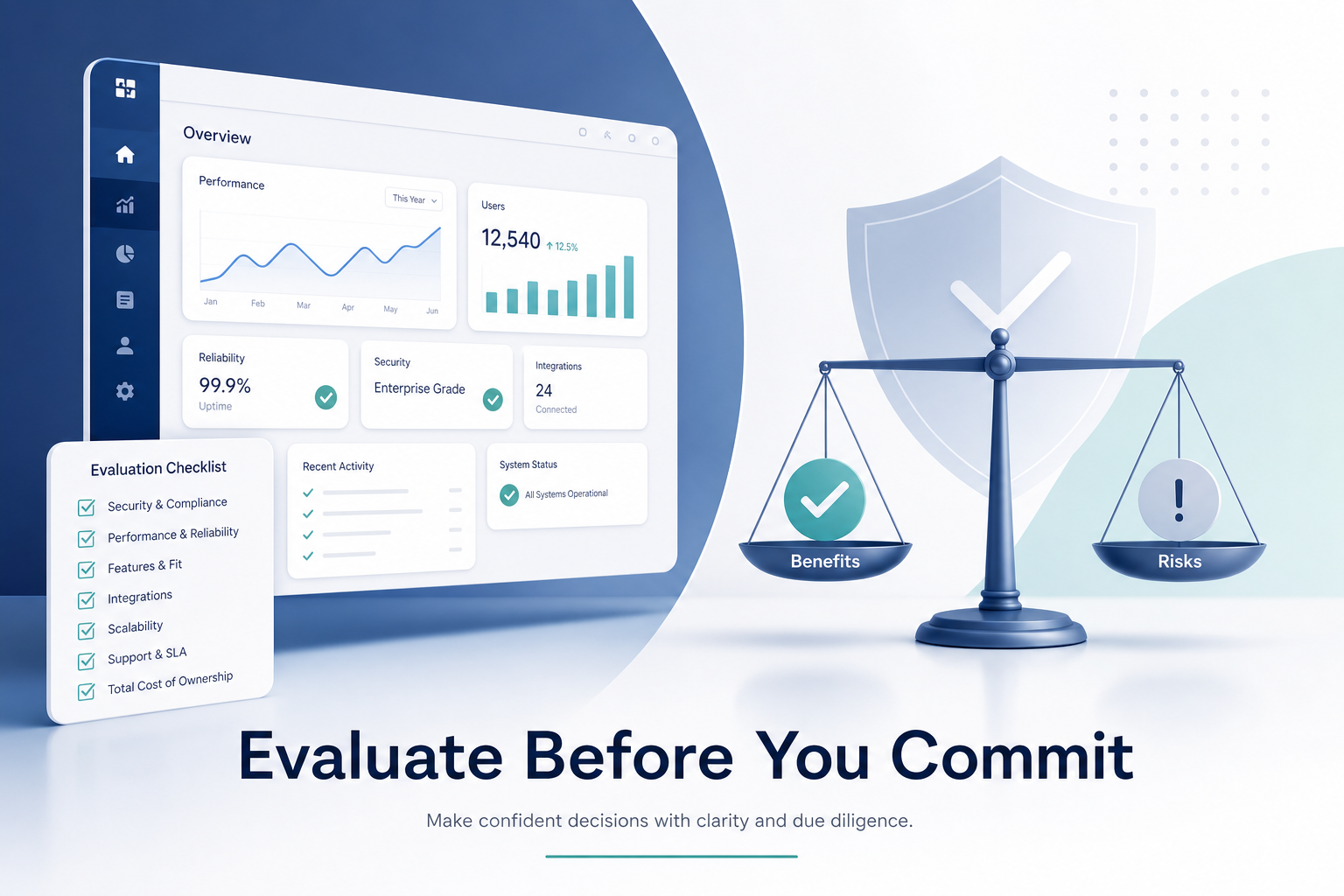
Choosing a digital platform is a strategic decision that shapes your digital transformation, not just an IT purchase. The wrong choice locks your organization into rigid architectures and high switching costs for years. When choosing digital platforms for businesses, it’s essential to consider scalability, user experience, and integration capabilities. A well-selected platform can enhance collaboration and streamline operations, leading to significant competitive advantages in the market. Investing time in thorough research and evaluation will pay off in the long run, ensuring that your organization can adapt to future challenges and opportunities.
This guide gives you a structured evaluation process to assess any new platform against your business objectives, real user workflows, and long term vision. You’ll learn practical techniques to reduce risk and find the right fit.
Table of Contents
ToggleKey Takeaways
Evaluate digital platforms against concrete business goals, actual workflows, and platform vision rather than feature checklists alone. When assessing the effectiveness of different solutions, it is crucial to employ software comparison strategies for businesses that align with both immediate needs and long-term growth plans. This approach enables companies to identify tools that not only fulfill current requirements but also adapt to future challenges and opportunities. By prioritizing strategic evaluation, organizations can make informed decisions that drive innovation and operational efficiency.
A structured framework covering goals, use cases, technical fit, total cost, and risk reduces the odds of failed digital transformation initiatives.
Run realistic pilots lasting 2–4 weeks with production-like data, integrations, and users before committing.
Align your platform strategy with your organization’s digital maturity stage and market context.
Establishing a solid digital strategy is essential for any organization looking to remain competitive and adaptable in today’s rapidly evolving technological landscape.
Quick Answer: How to Evaluate a Digital Platform in 7 Steps
Need an answer fast? Follow this checklist before you commit to any new platform. Each step builds on the previous one to create a complete evaluation process.
Clarify business goals – Define what success looks like in 12–18 months and 3–5 years. Low effort, foundational step.
Map critical use cases – Select 3–7 high-value workflows the platform must support. Medium effort, involves key stakeholders.
Assess technical and data fit – Check APIs, integrations, security, and data residency requirements. High effort, requires IT involvement.
Score features and usability – Rate platforms against weighted criteria using a consistent framework. Medium effort, reduces bias.
Run a real pilot – Test 2–3 finalists with actual users and data for 2–4 weeks. High effort but reduces long term risk substantially.
Calculate long term cost and ROI – Model total cost of ownership over 3–5 years, not just license fees. Medium effort, prevents surprises.
Check vendor stability and roadmap – Research financial health, support quality, and 12–24 month plans. Low effort, critical for partnerships.
Rank top choices based on price, usability, and how well they meet initial goals during the final assessment of digital platforms. Print this list and share it with your evaluation team.
What Is a Digital Platform and Why Evaluation Matters
A digital platform is a technology foundation that enables repeatable interactions and transactions between users, partners, and internal teams. Unlike standalone software, platforms leverage network effects where value increases as more participants join.
Examples from 2020–2025 include Salesforce for CRM, Shopify for ecommerce, AWS for cloud infrastructure, and internal data platforms for analytics. Digital platforms can enhance collaboration and innovation by enabling large-scale information sharing, which increases the platform’s value with each new participant.
These platforms underpin digital transformation initiatives by standardizing foundational capabilities like identity, payments, data access, and content delivery. When chosen well, they create competitive advantage through seamless integration and ecosystem leverage.
Research shows that poor platform choices lock organizations into rigid architectures. Gartner 2024 data shows 55% of digital transformation initiatives fail due to poor tech fit, often costing $1–10M in migrations.

Define Your Business Goals and Platform Vision
Evaluation starts with strategy. You must know why you need a digital platform before comparing vendors.
Organizations should clearly understand their short- and long-term performance goals when defining a digital strategy, focusing on either enhancing internal efficiency or outperforming competitors. Distinguish between short-term objectives (12–18 months) like reducing manual work and long term goals (3–5 years) like enabling new digital products.
Define a platform vision that states what business value the digital platform will create, for whom (customers, partners, employees), and how it supports broader digital strategy. A digital strategy should be flexible and forward-looking, allowing organizations to adapt to market conditions and competitor strategies while considering the potential for disruptive change.
Example vision statements:
“Launch a self-service customer portal by Q4 2026”
“Support three new digital revenue streams by 2028”
“Reduce partner onboarding time by 60% within 18 months”
Link goals to measurable outcomes like NPS, cycle time, or revenue share from digital channels. This gives you clear criteria for evaluating platform success.
Align with Digital Transformation Initiatives and Maturity
Platform evaluation must match your company’s digital maturity stage. Digital maturity significantly influences the strategic objectives and initiatives of digital transformation, with organizations at different maturity levels prioritizing different technology solutions.
Consider these stages:
Early stage – Focus on operational efficiency and basic integrations
Developing – Prioritize workflow automation and data consolidation
Advanced – Seek data products, AI features, and ecosystem play
Organizations at Stage 4 of digital maturity prioritize modernizing IT systems at a higher rate (55%) compared to those at earlier stages, who focus more on operational capabilities. The top digital transformation initiatives vary by digital maturity stage, with advanced organizations focusing on integrating customer touchpoints and accelerating innovation, while earlier stages prioritize operational improvements.
Misalignment is a major factor in failure. Buying an overly complex enterprise platform too early creates 6–12 month ramp-up delays when your business unit needs value in weeks. Document which initiatives (CRM modernization, ecommerce redesign, field service app) the platform must support in the next 1–3 years.
Clarify Your Appetite for Digital Disruption vs. Adaptation
Some organizations want to redefine their market. Others want to catch up and standardize. Your answer shapes platform requirements.
Organizations in regulated or conservative markets like banking or healthcare may favor adaptive digital strategy and proven solutions. Consider these examples:
Netflix (disruptive) – Rebuilt their entire architecture to handle 200M streams daily, requiring greenfield development
Siemens MindSphere (adaptive) – Integrated legacy industrial systems, achieving 99.9% uptime with lower risk
Questions to clarify your appetite:
Do we want to lead with a new platform business model or modernize current services?
Can we absorb 12–18 months of transformation journey before seeing results?
Does our market reward innovation or penalize instability?
Your answer shapes how aggressively you demand cutting-edge capabilities versus stability and compliance.
Map Critical Use Cases and User Journeys
Evaluate platforms by how well they support your most important workflows, not by generic feature lists. Select 3–7 high-value use cases tied to 2024–2026 business priorities. As you assess these use cases, consider the specific platform performance indicators in 2026 that will help guide your decisions. Look for metrics that align not only with current needs but also with anticipated industry shifts and technological advancements. This proactive approach will ensure that your platform selection remains relevant and effective in the years to come.
Example use cases:
Onboarding a new customer (reduce steps from 10 to 4)
Launching a marketing campaign (cut cycle time by 50%)
Publishing a new product line (integrate with ERP automatically)
Map each use case as a short user journey showing steps, roles, and touchpoints. This reveals which platform capabilities and integrations are essential. Include both customer experience journeys and employee-facing workflows since digital platforms serve multiple groups.
The implementation of digital platforms often allows employees to focus on more meaningful work by automating repetitive tasks, thereby improving overall job satisfaction and productivity. Capture pain points in current process flows like duplicate data entry, manual approvals, and handoffs that waste time.
Prioritize Use Cases by Value, Risk, and Effort
You cannot cover every scenario. Prioritize ruthlessly.
Use a simple scoring approach:
Criteria | Scale | Description |
|---|---|---|
Value to business | 1–5 | Revenue impact or cost savings |
User impact | 1–5 | Number of users affected daily |
Implementation effort | 1–5 | Dev hours and complexity |
Risk reduction | 1–5 | Compliance or operational risk addressed |
Choose 2–3 “must-win” use cases for pilots and vendor demonstrations. Early wins like self-service support or faster partner onboarding build buy-in for wider digital transformation. Lower-priority use cases can be deferred but should still be checked for long term platform fit.
Build a Structured Evaluation Framework
A documented scoring framework reduces bias and politics in platform selection. Evaluating and choosing the right digital platform requires clarity on your company’s key objectives to narrow down options effectively.
Keep criteria concise and aligned with goals. Prioritize functionality, integration capabilities, total cost of ownership, security/compliance, and vendor reputation when evaluating a digital platform.
Cover these key dimensions:
Functionality and features
User experience and usability
Integration and data capabilities
Scalability and performance
Security and compliance
Governance and administration
Vendor strength and support
Use the same framework across all shortlisted solutions so scores are comparable. Store it in a shared document that other stakeholders can review.
Define and Weight Evaluation Criteria
Translate goals and use cases into 10–20 concrete criteria with clear descriptions. Assign weights (10–30%) based on importance to your digital strategy.
Example criteria:
API maturity (documentation, SDKs, sandbox availability) – 15%
Role-based access controls – 10%
Low-code workflow configuration – 15%
Mobile support and PWA capability – 10%
Reporting flexibility – 10%
Ecosystem integrations – 15%
Roadmap alignment – 10%
Training and documentation – 15%
Differentiate between ‘needs’ and ‘nice-to-haves’ while listing must-have features of the digital platform, including key capabilities like security and analytics. Include at least one criterion about change management support to drive user adoption.
Combine Quantitative Scores with Qualitative Insights
Numbers alone cannot capture culture fit, user sentiment, or vendor partnership quality.
Use a 1–5 scoring scale for each criterion plus a short free-text comment for context. Hold team review sessions where business, IT, security, and operations stakeholders discuss score differences.
Qualitative notes are especially important for assessing:
Usability during real tasks
Support responsiveness during evaluation
Implementation experience from reference customers
Revisit scores after pilots. Perceptions often change once users test the platform with actual workflows and real data.
Evaluate Technical Fit, Integration, and Data Capabilities
Most digital platforms fail not because of missing features but due to integration and data issues in production. Gartner reports 31% of platform failures stem from integration problems.
When evaluating digital platforms, organizations should ensure that the technology and user experience are up-to-date and capable of integrating with existing systems and applications. Create a one-page map of your current tech stack (CRM, ERP, analytics, identity, collaboration tools) that the platform must connect to.
Involve solution architects and data leads early. Assess if the technology can handle increasing data volume, user growth, and future, unforeseen business needs. Consider cloud strategy and regional data residency requirements now, not after purchase.
APIs, Extensibility, and Ecosystem
Confirm the platform integrates easily with existing systems through strong APIs, supports data portability, and possesses robust, secure technology.
What good APIs look like:
Clear documentation with versioning
Sandbox environments for testing
SDKs in multiple languages
Webhook support for event-driven integrations
Deprecation policies for breaking changes
Digital platforms can create significant opportunities for growth and innovation by providing a flexible technological foundation that supports seamless integration of internal and external applications. Check the ecosystem of apps, partners, and pre-built integrations. Platforms like Salesforce with 1,000+ integrations reduce development time significantly.
Strong ecosystem support signals the platform can evolve with future digital disruption and new technology requirements.
Data, Security, and Compliance
Ensure the vendor adheres to necessary data protection regulations, offers robust security protocols, and provides data auditing tools.
Key topics to evaluate:
Data model flexibility (JSON vs. rigid SQL)
Data quality and lineage tools
Audit trails and access controls
Encryption in transit and at rest
Zero-trust security models
Check for compliance with GDPR, CCPA, SOC 2, ISO 27001, HIPAA, or industry-specific regulations. Request documentation on data residency options, backup policies, and incident response procedures.
Test security features during the pilot, not just from marketing materials.
Usability, Adoption, and Change Management
McKinsey reports 50–70% of digital transformation initiatives fail due to poor user adoption, not technology limitations. This makes usability evaluation critical.
Evaluate if the platform meets current needs and offers necessary customization, ease of use, and a positive user experience. Test platforms for how easy they are to learn for different roles: end users, administrators, and software engineering teams.
Usability test scenarios:
Onboarding new hires to the platform (target: under 30 minutes)
Creating a basic workflow (target: no code required)
Generating a standard report (target: under 5 minutes)
Look for built-in guidance features like tours, contextual tips, and help content. Strong training programs and community resources are critical success factors.
Organizational Readiness and Support
Assess internal readiness: skills, capacity, governance processes, and sponsorship. Building a digital platform requires a fundamental shift in business, culture, and mindset, necessitating new digital ways of doing business and adjustments in processes and technology systems.
Identify platform “champions” in each business unit who can support peers during rollout. Agree on adoption metrics before implementation: create robust training sessions focusing on strategies for seamless platform transitions to ensure all users are equipped to adapt efficiently. Incorporate feedback mechanisms to continuously improve the experience, aligning with the established adoption metrics. This collaborative approach will foster engagement and commitment across the organization.
Daily/monthly active users
Feature usage rates
Time-to-proficiency for new users
Ensure the vendor provides adequate onboarding and support, especially if the tool is complex, before making a final decision. Change communication—explaining why the new platform matters for customer satisfaction and business success—should be part of leadership discussions.
Cost, Value, and Long-Term ROI
License fees are only a portion of true cost. Analyze total cost of ownership including licensing fees, subscription costs, professional services, training, and potential hidden costs against expected ROI.
TCO breakdown over 3–5 years:
Cost Category | Typical % |
|---|---|
Licenses/subscriptions | 20% |
Implementation | 30% |
Ongoing operations | 50% |
Determine your budget and the number of users to identify cost-effective options while avoiding hidden per-user fees. Create cost models comparing scenarios across platforms with both best-case and realistic estimates.
Ensure the platform aligns with specific business goals and scales with growth, offering robust APIs for interoperability and strong customer support for long-term ROI. Bain research shows well-aligned platforms deliver 3–5x ROI multiples.
Evaluating Vendor Stability and Roadmap
You are entering a multi-year partnership, not a one-off purchase. Research the vendor’s reputation, financial stability, and quality of customer support to ensure reliability as a long-term partner.
Evaluation checklist:
Financial health (funding rounds, revenue growth)
Customer base size and retention
Leadership stability
12–24 month product roadmap
Support models and SLAs
Escalation paths for critical incidents
Look for roadmap alignment with your platform strategy. If you need AI capabilities or regional expansion by 2027, confirm vendors plan to develop these features.
Vendor responsiveness during evaluation often predicts long term support quality.

Run Realistic Pilots and “Try Before You Buy”
Hands-on pilots with real users and data are the most reliable way to compare digital platforms. A robust framework for evaluating digital platform options should consider the platform’s limitations, required infrastructure, and the expected return on investment (ROI).
Pilot structure recommendations:
Duration: 2–4 weeks per finalist
Focus: 2–3 priority use cases defined earlier
Participants: Cross-section of business, IT, and operations users
Data: Production-like data (anonymized if needed)
Test integrations, performance under realistic loads, and administrative tasks—not just front-end features. Define clear success criteria before pilots start, such as reduced steps or faster time-to-completion.
Measuring Pilot Outcomes and Making Trade-Offs
Capture pilot feedback using surveys, interviews, and platform analytics. Research from Dropbox and Zerve shows pilots reduce regret by 60%.
Score each platform again after pilots, updating earlier estimates. No platform scores highest everywhere. Organizations must make conscious trade-offs aligned with business strategy.
Create a short decision memo summarizing:
Why one platform was chosen
Which risks remain
How risks will be managed
Document this rationale for future reviews and measuring long term impact.
Comparison Table: Techniques to Evaluate Digital Platforms
Different evaluation techniques require different effort levels. Use this table to plan your evaluation process based on available time and resources.
Technique | Intensity | Risk if Skipped | Best For |
|---|---|---|---|
Feature Checklist Review | Low (1 week) | Medium | Initial filtering |
Stakeholder Workshops | Medium (2 weeks) | Low | Alignment and buy-in |
Technical Deep-Dive | High (3 weeks) | High | Architecture fit |
Scored RFP | Medium-High | Low-Medium | Vendor comparison |
Hands-On Pilot | Very High (4 weeks) | Very Low | Final validation |
Start with lighter techniques to narrow your shortlist. Reserve intensive pilots for 2–3 finalists to avoid spreading your team too thin.
Guidance for Different Types of Organizations
Evaluation approach should vary by organization size, complexity, and digital maturity. Clearly outline organizational objectives to determine specific goals such as automation, sales growth, or internal communication when assessing a digital platform.
Small and mid-sized businesses:
Prioritize ease of use and out-of-the-box functionality
Seek quick time-to-value with minimal software engineering
Focus on tools that handle several factors without extensive customization
Large enterprises:
Emphasize integration with legacy systems and governance
Require compliance, global scalability, and deep understanding of complex data flows
Plan for multi-business unit rollouts through 2026 and beyond
Digital-native companies:
Highlight extensibility, APIs, and experimentation speed
Support advanced analytics, AI, and rapid feature ideas development
Enable consumers and developers to build on the platform
Common Mistakes to Avoid When Choosing a Digital Platform
Many organizations repeat avoidable errors. Learn from others’ failures.
High-impact mistakes:
Focusing only on price while ignoring 60% of hidden costs
Ignoring user experience and assuming “users will adapt”
Underestimating integration work and data migration complexity
Chasing buzzwords like “AI-powered” without validating real value
Choosing based on a single stakeholder’s preference without structured evaluation
Committing without a pilot using real workflows and data
Skipping sales demo sessions that reveal actual capabilities
Schedule regular reviews (annually) to ensure your platform continues to support evolving digital strategy. Markets evolve, new technology emerges, and your needs will change.
FAQ
These questions address common concerns not fully covered above. Each answer provides practical guidance for your transformation journey.
How long should we allocate to evaluate a new digital platform?
Most organizations should plan 4–8 weeks for full evaluation, including requirements gathering, vendor demos, a deeper dive into technical fit, and at least one hands-on pilot. Complex enterprise platforms or multi-region deployments may need 3–4 months when security, compliance, and data migration are involved.
Avoid rushed 1–2 week evaluations. These often lead to regret and costly changes within 18–24 months. Build evaluation time into the roadmap for any major digital transformation initiative.
Who should be involved in digital platform evaluation?
A balanced team includes business owners, IT/architecture, security/compliance, operations, and sample end users. Appoint a clear decision owner while ensuring each stakeholder group provides input on criteria and pilots.
Excluding security or data teams early often leads to rework when hidden constraints emerge. Involve executive sponsors at major checkpoints to maintain alignment with long term strategy.
How many platforms should we shortlist before piloting?
Start with a broad scan but narrow quickly to 3–5 candidates for detailed comparison. Run full pilots with only 2–3 finalists. Piloting too many platforms spreads teams thin and delays decisions.
Initial elimination can use high-level fit criteria: industry focus, compliance certifications, deployment model. Document why options were removed so you can revisit if market conditions change in 12–24 months.
How often should we re-evaluate an existing digital platform?
Conduct a light review annually, checking alignment with current strategy, customer satisfaction levels, and new requirements. A deeper evaluation every 3–5 years—or when major shifts occur like mergers, new regulations, or significant digital disruption—keeps you current.
Re-evaluation doesn’t always mean replacement. It can lead to new modules, better integrations, or improved governance. Track platform-related KPIs over time to know when formal review is needed.
What’s the difference between evaluating a product and a digital platform?
A product is typically a self-contained solution. A digital platform is a foundation for multiple products, services, and integrations that can develop and evolve over time.
Platform evaluation must consider ecosystem potential, extensibility, governance, and platform vision—not just immediate features. Platform choices have broader architectural impact and higher switching costs, making structured evaluation more critical. A good platform decision supports several future digital transformation initiatives, not just the current project.