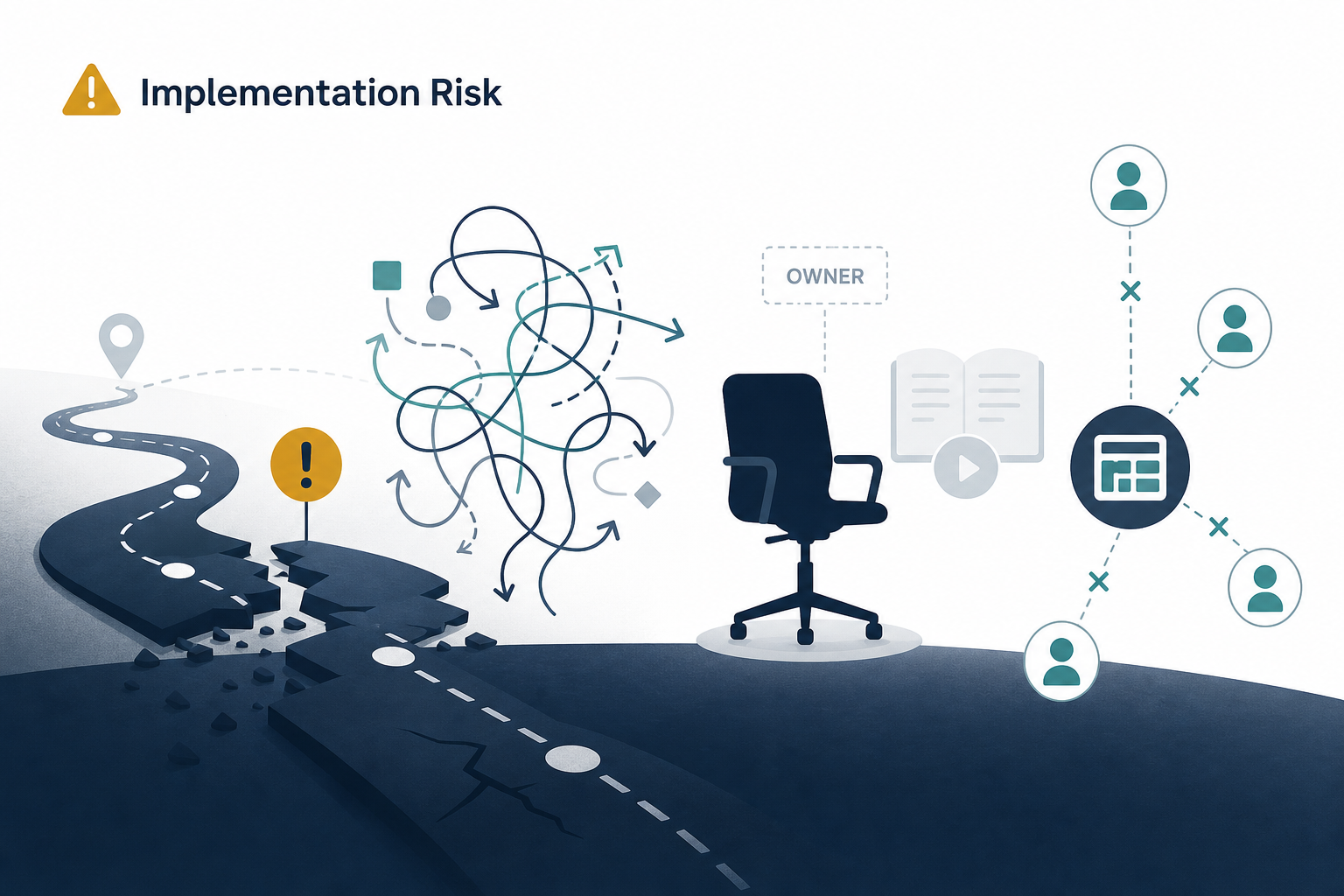
Most platform implementations don’t fail because the software is broken. They fail because organizations rush into technology decisions without aligning business needs, data readiness, and people. This article breaks down the concrete patterns behind implementation failure and shows you how to avoid them.
Table of Contents
ToggleKey Takeaways
Platform implementation covers ERP systems, data platforms, PLM, CMS, and other enterprise software. Between 60-70% of large software implementations fail to meet objectives according to studies from Standish Group and McKinsey.
The same failure patterns repeat across ERP systems, data platforms, and other enterprise software: vague business goals, weak change management, poor data foundations, and treating platforms as one-off projects.
Over 70% of digital transformations fail due to organizational, architectural, and design friction—not technology defects.
Success depends on early alignment, realistic phasing, strong governance, and ongoing stewardship after go-live.
This article will show concrete failure patterns, what they look like in real projects, and what to do differently.
Quick Answer: Why Most Platform Implementations Fail
Platform implementations fail because organizations rush to buy technology before aligning business needs, data, people, and ongoing ownership. The technology itself is rarely the problem. Unsuccessful platform implementations typically fail due to a combination of poor planning, cultural resistance, and technical mismanagement.
The top 5 reasons platforms fail:
No clear business problem or measurable outcomes
Weak change management and lack of buy in from key stakeholders
Unrealistic scope, timelines, and project design
Poor data quality and integration foundations
No post-launch governance or product ownership
In 2023, a global manufacturer rolled out SAP S/4HANA across 15 sites. The software went live, but 65% of users reverted to spreadsheets because data cleansing covered only 40% of legacy records and training reached just 30% of staff. The result: $20M in annual process inefficiencies despite a “successful” go-live.
These patterns apply across software implementations: ERP systems, data platforms, PLM tools, and marketing or content platforms. Research shows that 85% of platform implementation failures are linked to faulty ecosystem design. The following sections unpack each failure mode and show how to avoid it.
What We Mean by “Platform Implementation” (and Why Projects Fail So Often)
A platform in this context means enterprise software that sits at the core of business operations: ERP systems like SAP or Oracle, modern data platforms like Snowflake or Databricks, PLM tools like Siemens Teamcenter, CRM systems like Salesforce, and CMS platforms like Adobe Experience Manager. When evaluating options, businesses should focus on strategies for selecting digital platforms that align with their specific operational needs. By carefully assessing features, scalability, and support services, companies can make informed decisions that enhance their workflow. It is essential to consider not only current requirements but also future growth potential when choosing the right tools. understanding platforms vs systems is crucial for businesses aiming to optimize their infrastructure. Platforms often provide the flexibility and integration capabilities necessary for scalability, while systems typically focus on specific functionalities. By differentiating between these two, companies can better tailor their technology stack to support both immediate needs and long-term objectives.
Implementation covers the entire journey:
Requirements gathering and architecture design
Configuration and custom development
Data migration and integrations
Change management and user training
Go-live and ongoing support
This is not just installing software. It typically spans 6-24 months for large organizations.
The scale of the problem is significant. Up to 66% of large-scale technology projects end in partial or total failure because organizations underestimate the non-technical complexities of digital transformation. Panorama Consulting’s 2023 ERP Report found 55% of ERP projects exceeded budgets by 50% or more.
Visible symptoms when implementations fail:
Users revert to old tools and workarounds
Reports conflict and data becomes untrusted
Operations teams create shadow processes
Leadership loses confidence in the digital platform
The root causes sit in five domains: strategy, scope and planning, data, people and change management, and long-term governance.
Reason 1: No Clear Business Problem or Value Case
Many platforms fail because they were purchased to “modernize” or create a “single source of truth” without a precise business problem or measurable goals. Poor requirements gathering accounts for over 39% of software failures.
Common issues that lead to failure:
Vague objectives without agreed KPIs
Conflicting goals between departments (finance wants compliance, operations teams want speed)
Missing baseline metrics for measuring success
Sales process promises that inflate capabilities
In ERP and data platform projects, this manifests as teams building dashboards no one uses or chasing features that don’t improve core processes. Many teams enter UAT only to hear “this isn’t what we expected.”
Revlon’s 2018 SAP rollout cost over $100M and collapsed because no prioritized processes were defined. The result was unintegrated inventory systems and $70M in lost revenue from stockouts.
A good value case includes:
3-5 clear business outcomes with owners
Baseline metrics measured before implementation begins
Specific process improvements (e.g., reduce order-to-cash from 45 to 20 days)
Failure to define clear goals and realistic timelines is a common cause of implementation failure. Write this down before any implementation project kicks off.
Reason 2: Unrealistic Scope, Timelines, and Project Design
Many implementations fail because they try to do too much, too fast. A “big bang” approach across all sites, processes, and regions fails 82% of the time versus 35% for phased approaches.
Overly ambitious implementation projects can lead to failure, as they become too complicated to manage effectively, resulting in stalled progress and dysfunction.
The U.S. Navy’s ERP saga illustrates the danger. Between 2004 and 2019, they spent over $1B on SAP before cancellation. The global scope across 80+ commands overwhelmed data harmonization and the project collapsed under its own complexity.
Typical scope problems:
Global rollouts in one wave without testing
Copying every edge case from legacy systems
Excessive customization that recreates old business logic in new software
System Integrator pressure for rapid billing and standard templates
Many IT implementations fail because the budget isn’t adequately scoped or managed, leading to excessive costs and abandonment of the project. A common mistake in budget management during IT implementations is spending excessively on edge cases, which can drain resources needed for other components of the project.
What works instead:
Phased delivery in 4-8 week increments by region or process
Clear rules for Day 1 MVP versus later phases
To avoid budget overruns, it is recommended to over-budget by 20% to allow for unexpected expenses during IT implementations

Reason 3: Weak Change Management and Lack of Buy-In
Change management remains chronically underfunded and underplanned across enterprise software projects. Yet it is the single biggest predictor of whether implementations fail or succeed. The most common cause of implementation failure is ignoring the human element of technology adoption.
Employee resistance to change is a common challenge in software implementations, as onboarding new software is nearly impossible if end users are not interested or comfortable with existing workflows.
Core change management failures:
No executive sponsor visible to the organization
One-way communication (emails instead of town halls)
Training on mockups instead of near-final systems
Ignoring frontline concerns about workflows or job impact
Organizations that invest heavily in technology without equally investing in user engagement and change management often find themselves with systems that are underutilized and not trusted by employees.
The UK NHS’s Lorenzo EHR program cost £10B and failed because clinicians reverted to paper after training was skipped. Projects that lack a change management plan face quiet resistance that erodes adoption from day one.
Effective change management is a systematic approach to dealing with the transition or transformation of an organization’s goals, processes, or technologies. It should start before implementation begins—not as an afterthought.
What success looks like:
Sponsor-led roadshows monthly
Role-based training with 80%+ completion
Incentives aligned to adoption KPIs
Feedback loops through pulse surveys
Organizations that treat change management as an afterthought or delegate it entirely to the implementation vendor are likely to face quiet resistance that erodes adoption.
Reason 4: Underestimating Data and Integration Complexity
Data and integrations quietly derail software implementations. The new platform “works,” but data is wrong, incomplete, or late—and integrations fail under real load. Panorama’s 2024 report found data issues cause 62% of ERP failures.
Organizations that migrate years of legacy data without first auditing it often find that the new system inherits all the disorder of the old one, leading to implementation challenges.
Typical data problems:
25% duplicate customer records
40% incomplete bills of materials
Schema mismatches between ERP and CRM systems
Rushed field mapping without testing edge cases
FoxMeyer Drugs’ 1996 SAP implementation collapsed from bad inventory data, resulting in $600M in losses. Modern data platform projects face similar issues: a 2022 Big Four bank’s Snowflake project saw 35% of data ingestion break on schema evolution.
Integration mistakes to avoid:
Point-to-point connections without clear contracts
Missing abstraction layers (no middleware like MuleSoft)
Late discovery of external systems that must connect
A common reason for software implementation failures is the lack of comprehensive testing and change management, which can lead to adoption issues and data integrity problems.
What works:
Early data profiling with tools like Collibra
3-5 migration test cycles before cutover
Clear data governance roles and validation rules
Reason 5: Treating the Platform as a One-Time Project, Not a Product
Many platforms fail after Year One because organizations treat implementation as a project that ends at go-live. Without ongoing stewardship, 50% of platforms lose 30% of their value within 12 months.
Symptoms by Year Two:
Rising cloud and license costs (20-40% unused licenses)
Slow performance and growing technical debt
Backlog of 500+ unprioritized change requests
Users losing trust in reports and workflows
Without a platform owner, small post-launch decisions cause “platform drift.” Ad-hoc fields break reports. Shortcuts undermine architecture design. The new system gradually becomes as messy as the old one. To maintain a successful system, attention must be given to platform fit versus feature overload. Striking the right balance ensures that additional features enhance user experience rather than complicate it. A cohesive strategy can help prevent unnecessary complexity, allowing for sustainable growth and adaptability. managing tool overload in workplaces is crucial for maintaining productivity and efficiency. Teams can become overwhelmed by the sheer number of applications and systems in use, leading to frustration and decreased performance. By streamlining tools and establishing clear processes, organizations can create a more focused and harmonious work environment.
Lidl’s 2018 SAP S/4 migration initially drifted, costing €500M in rework before a product team stabilized it.
What a product mindset looks like:
Named platform owner (VP level)
Quarterly roadmaps with business input
OKRs for platform health (e.g., 95% uptime, adoption stalls tracked)
FinOps for cost monitoring
Capacity reserved for refactoring and governance
Most platforms that achieve long-term success are managed as products with roadmaps, not projects with end dates.
Reason 6: Misaligned Partners, Methods, and Governance
Misalignment between internal teams, System Integrators, and software developers leads to fragmented decisions and blame shifting. Gartner reports these misalignments cause 40% of project delays.
Specific misalignments:
Different methodologies (Agile vs. waterfall)
Unclear RACI (who decides versus who advises)
Conflicting incentives (vendor speed vs. client risk management)
Projects that lack sufficient definition and planning due to the absence of a project charter and project plan tend to move forward in an uncoordinated manner, showing little progress.
Governance gaps that kill projects:
Weak steering committees meeting monthly instead of weekly
Infrequent decision forums with missing stakeholders
Project reporting that hides risks until they become crises
Effective project governance is paramount to the success of any complex project because it identifies critical participants, defines the project’s oversight and governing framework, and fosters buy in from senior management.
LA County’s 2015 ERP project ballooned from $181M to $720M due to poor oversight documented in state audits.
Simple governance structure that works:
Executive sponsor accountable for outcomes
Cross-functional steering group meeting weekly
Named platform owner for ongoing decisions
Change advisory process for scope management
Regular checkpoints reviewing scope, risk, and value
Establishing strong project governance allows critical organizational resources to become invested in the project, providing a platform for input and guidance, and securing essential resources necessary to execute the plan.
What Successful Implementations Do Differently
Successful implementations use similar technology to failing ones. The difference is decisions about scope, ownership, and operating model.
Concrete practices that enable success:
Define a sharp business case with 3-5 measurable outcomes
Phase delivery by process or region (order-to-cash first, then procure-to-pay)
Invest early in data quality and integration design
Run real change management with dedicated budget (15-20%)
Assign product ownership from Day 1
Embed governance before implementation begins
Nestlé’s phased SAP rollout delivered 20% ROI by focusing on individual business units sequentially. A retail bank’s data platform project invested more in semantic modeling than ingestion tools—and achieved trusted analytics in Year One.
Metrics successful teams track:
Process cycle times (order-to-cash, marketing campaigns turnaround)
Error rates and data quality scores
User adoption and NPS
Platform costs vs. value delivered
Successful teams continuously measure value and adjust the roadmap. They don’t declare “done” at go-live.
Platform implementation is a repeatable discipline, not a gamble, when these practices are followed.

Practical Steps to Rescue or De-Risk Your Platform Project
If you’re already in trouble—late projects, budget overruns, adoption stalls, or leadership questioning the new platform—recovery is possible. Research suggests 80% of troubled implementations are recoverable.
Recovery sequence:
Pause and assess: Run a 4-week health check across scope, data, change management, and governance
Stabilize: Fix the most harmful failure modes first
Re-plan: Define a smaller, value-driven scope for the next phase
High-level actions:
Audit data quality and identify critical gaps
Validate integrations under real workloads
Interview key user groups about adoption blockers
Clarify sponsorship and decision rights
Sometimes the issue is not the technology but how it was configured, governed, and evolved. Separates platforms from implementation failures before deciding to abandon the system.
Create a renewed roadmap:
60-90 day focus on quick, visible wins
12-month plan for governance, training, and platform stewardship
Clear success metrics tied to initial delivery goals
Progress becomes visible when you stop trying to fix everything and focus on what matters most to the business.
FAQ: Common Questions About Why Platform Implementations Fail
Do platforms usually fail because the software is bad?
Most modern ERP, data platform, and PLM products are technically sound. They succeed at many companies worldwide. Failures usually stem from poor fit, rushed design, or weak change management—not software defects. Before replacing a platform, evaluate whether problems come from configuration, data quality, integrations, or operating processes.
How can we tell early if our implementation is going off track?
Watch for slipping milestones without root-cause analysis, constant scope changes, low attendance at workshops, unresolved data issues, and frontline users saying they “haven’t seen” the new system. Track decision turnaround time, testing coverage, data migration progress, and training environment usage monthly.
Is “big bang” deployment always a bad idea?
Big-bang go-lives across many processes and regions fail about 80% of the time for complex ERP systems. They can work in narrow, well-bounded cases with strong rehearsal and rollback plans. Most organizations achieve better success with phased rollouts by business unit or process.
How much should we invest in change management compared to technology?
Many organizations spend almost all budget on licenses and integrators. Effective change management is crucial for user adoption, as it involves aligning people, processes, and incentives around the new way of working. Dedicate 15-20% of budget and visible leadership attention to communication, training, and adoption support.
When is it better to fix a failing implementation versus starting over?
It’s usually cheaper and faster to repair a troubled implementation than replace the entire platform. Consider a restart only when there’s a fundamental mismatch in capability, architecture, or functionality that no realistic fix can solve. Base the decision on a structured, independent assessment—not frustration.